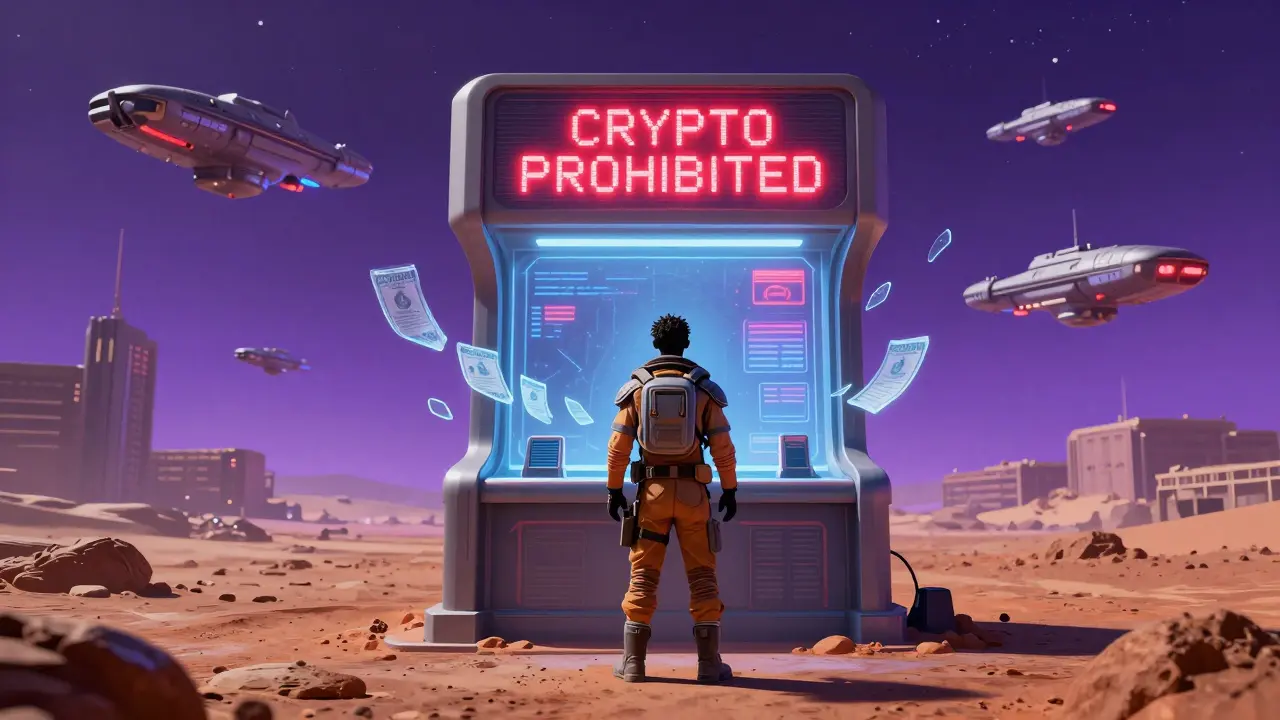
Namibia Crypto License Status Checker
Deadline
Provisional License
May 13, 2025
Status: Awaiting full regulatory approval
Currently not serving customers
Currently not serving customers
As of 2025, if you’re trying to use Bitcoin or any other cryptocurrency in Namibia, you’re navigating one of the most confusing financial environments in Africa. You can’t legally buy crypto with your bank account. You can’t open a crypto wallet linked to your NedBank or Standard Bank card. And if your bank notices you’ve been trading digital assets-even just once-you might wake up to find your account frozen. Yet, somehow, three crypto companies have been given special permission by the central bank to operate… but only behind closed doors.
Why Can’t You Use Crypto in Namibia?
The short answer: the Bank of Namibia (BON) doesn’t recognize cryptocurrency as money. Back in May 2018, the central bank issued a clear warning: Bitcoin, Ethereum, and other digital assets are not legal tender. They’re not backed by the government. And if you lose money trading them? Tough luck-you have no legal protection. That wasn’t just a statement. It was a policy. Banks were told not to process crypto-related payments. Accounts linked to crypto exchanges were flagged and shut down. People who ran crypto investment clubs saw their savings locked overnight. No court order. No formal charge. Just a notice from the bank: "Your account is restricted due to suspicious activity." Even though the government passed the Virtual Assets Act of 2023-a law designed to bring crypto under regulation-the central bank still refuses to say crypto is legal for regular people to trade. That contradiction is at the heart of the problem.The Virtual Assets Act of 2023: A Law That Doesn’t Apply to You
In June 2023, Namibia’s National Assembly passed the Virtual Assets Act (Act No. 10 of 2023). This law created a licensing system for crypto businesses. It required all Virtual Asset Service Providers (VASPs) to register with NAMFISA, the country’s financial watchdog. It forced them to follow strict anti-money laundering rules. It even adopted the global "Travel Rule," meaning any crypto transaction over NAD 20,000 (about $1,000) must include full identity details of both sender and receiver. But here’s the catch: this law only applies to companies. It doesn’t say anything about whether individuals can buy, sell, or hold crypto. The law says nothing about making crypto legal for the public. It only says: "If you run a crypto business, here’s how you get a license." So while businesses can now apply for permits, regular Namibians are still stuck in legal limbo. You can’t open a crypto account. You can’t use it to pay for groceries. And if you try, your bank might shut you down.Who Got Permission to Operate? And Why Can’t They Serve You Yet?
In January 2025, the Bank of Namibia granted provisional licenses to three companies: Landifa Bitcoin Trade CC, United PayPoint (Pty) Ltd, and Mindex Virtual Asset Exchange. These are the only crypto businesses in Namibia allowed to exist under the new law. But here’s the twist: they’re not allowed to serve anyone yet. Each company has a six-month provisional period to prove they can operate safely. They must build secure systems, hire compliance officers, set up record-keeping tools, and pass audits. During this time, they can’t interact with customers. They can’t accept deposits. They can’t process trades. They’re essentially in a regulatory waiting room. Two of the three companies asked for extensions. Landifa got pushed to July 31, 2025. United PayPoint’s deadline moved to May 13, 2025. Mindex got an extension until November 21, 2025. The bank says it’s still reviewing their compliance. That means even if you’re ready to use crypto, the companies that could help you still aren’t.
What Happens After the Six Months?
The Bank of Namibia hasn’t said what happens next. There’s no public timeline. No guarantee of approval. The law gives them full discretion: they can approve, reject, or extend the provisional status indefinitely. If a company passes inspection, they’ll get a full license. Only then can they start serving customers. But even then, it won’t mean crypto is legal for everyone. It just means those specific companies can operate under strict rules. You’ll still need to go through them to trade. No peer-to-peer. No international exchanges. No self-custody wallets connected to your bank. And if they fail? The bank can shut them down. No appeal process. No public explanation. Just silence.Why Are Banks Still Blocking Crypto Accounts?
Despite the new law, major banks like NedBank and Standard Bank continue to freeze accounts tied to crypto activity. Legal experts say this is a problem. The Bank of Namibia doesn’t have the legal power to tell commercial banks how to run their customers’ accounts. Only courts can issue orders like that. Yet, banks are doing it anyway. Why? Because they’re afraid of regulatory backlash. If a bank processes a crypto payment and the central bank later says it violated policy, the bank could face fines or lose its own license. So the safest move? Block everything. This has created a chilling effect. People who invested in crypto years ago are now afraid to even mention it to their bankers. Some have closed their accounts and moved money offshore. Others have stopped trading altogether.


I'm a blockchain analyst and crypto educator who builds research-backed content for traders and newcomers. I publish deep dives on emerging coins, dissect exchange mechanics, and curate legitimate airdrop opportunities. Previously I led token economics at a fintech startup and now consult for Web3 projects. I turn complex on-chain data into clear, actionable insights.