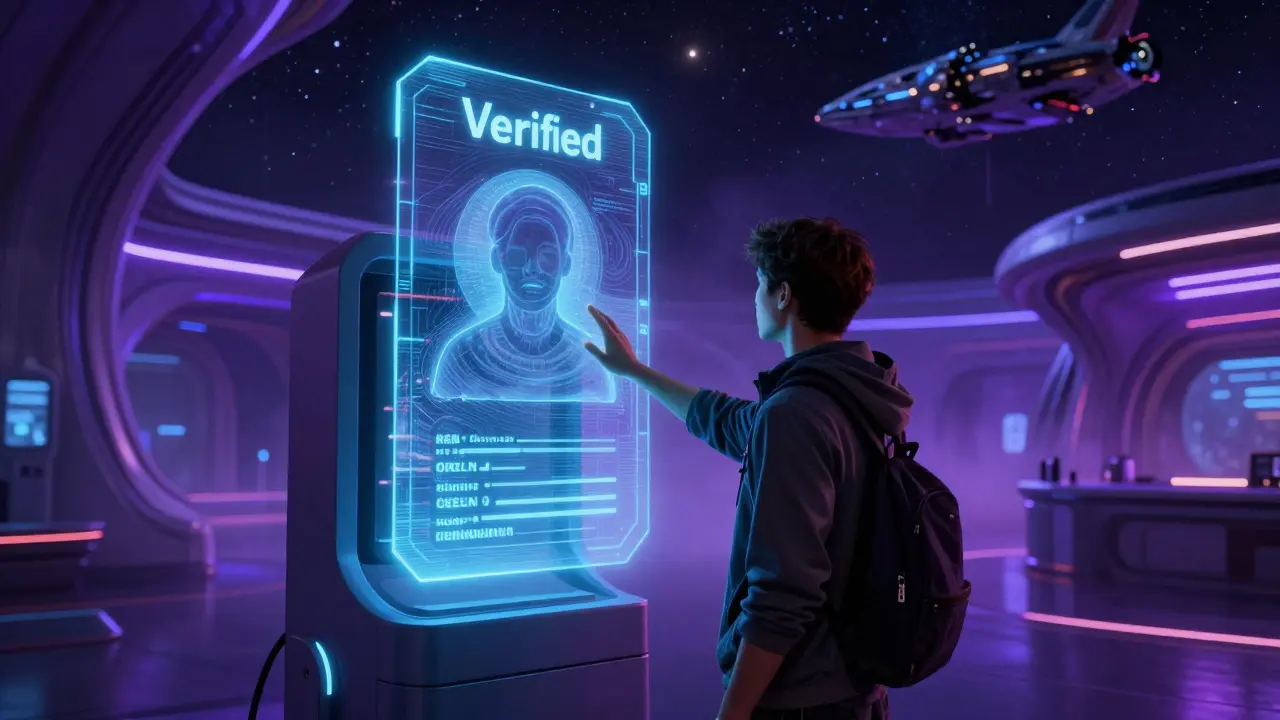
Privacy-Preserving Verification Simulator
See how privacy-preserving verification works in practice. Enter your age to simulate a verification request where only the necessary information is revealed.
How this works: Unlike traditional systems that reveal your full birthdate, this simulates Zero-Knowledge Proofs where only the necessary information (e.g., "over 21") is shared without revealing sensitive data.
Imagine showing your driver’s license to prove you’re over 21 - but the bouncer only sees "yes, over 21" and nothing else. No name, no address, no photo. No copy stored anywhere. That’s not science fiction. It’s privacy-preserving identity verification - and it’s already changing how we prove who we are online.
Traditional identity systems are broken. You hand over your passport to a bank. You upload your SSN to a gig app. You scan your face for a ride-share driver. Every time, your data gets copied, stored, and exposed. One breach, and your entire digital life is at risk. In 2024 alone, over 1.2 billion records were exposed in identity-related breaches. People are tired of trading their privacy for convenience.
Privacy-preserving identity verification flips the script. Instead of giving away everything, you prove only what’s needed - and nothing more. This isn’t about hiding your identity. It’s about owning it.
How It Works: Zero-Knowledge Proofs and Decentralized Identifiers
The backbone of this system is two technologies: Zero-Knowledge Proofs (ZKPs) and Decentralized Identifiers (DIDs).
ZKPs let you prove something is true without revealing the truth. For example: you can prove you’re a U.S. citizen without showing your passport. You can prove you’re 32 years old without saying your birthdate. The math behind it is complex - but the effect is simple. The verifier gets a cryptographic guarantee that your claim is valid. They learn nothing else.
DIDs are your personal identity keys. Unlike traditional IDs issued by governments or corporations, DIDs live on your phone or wallet. You control them. No central database holds your data. When you verify your age for a cannabis dispensary, your DID sends a signed proof - not your birth certificate. The dispensary checks the signature. That’s it.
Together, ZKPs and DIDs create a system where you’re not a data point in someone else’s server. You’re the owner. The verifier? Just a checker.
Why This Beats Traditional ID Systems
Old-school identity verification works like this: you give data → they store it → they share it (sometimes without telling you) → they get hacked.
Privacy-preserving systems work like this: you prove what’s needed → they verify it → they forget it → you keep control.
Take KYC (Know Your Customer) for banks. Normally, you send them your ID, selfie, utility bill, and tax number. They store it all. If their system gets breached, your identity is sold on the dark web. With privacy-preserving KYC, you generate a ZKP that proves you’re not a criminal, that your ID is real, and that you’re over 18. The bank doesn’t see your name, address, or photo. They get a cryptographic stamp: “Verified.”
GDPR and CCPA force companies to minimize data collection. But most still collect too much - because they don’t know how else to verify. Privacy-preserving tech gives them a legal, secure way to comply. No more storing your mother’s maiden name just because “it’s always been done.”
Real-World Uses Today
This isn’t theoretical. It’s live.
Banks like JPMorgan and Revolut are using ZKPs for KYC. Users upload documents once. From then on, they prove eligibility with a tap. No re-uploading. No data stored by the bank.
Healthcare providers use it to confirm patient identity for telehealth visits. You prove you’re the person on the record - without handing over your medical history or SSN. Your diagnosis stays private. Your identity stays secure.
Government services in Estonia and Sweden let citizens log into tax portals, voting systems, and healthcare records using DIDs. No passwords. No central registry. Just a secure digital key you control.
Travel is next. Airports in Amsterdam and Singapore are testing “digital passports” that prove you’re cleared for travel without showing your full passport data. Your flight info, visa status, and health records are verified behind the scenes. You just walk through.
Even ride-sharing apps like Uber are testing it. Instead of uploading your driver’s license to a cloud server, you prove you have a valid license using a ZKP. The app doesn’t store your license number - just a yes/no answer.

The Tech Behind the Magic
It’s not just ZKPs and DIDs. Other tools make this work at scale.
Selective Disclosure lets you pick what to share. Need to prove you’re over 18? Share only age. Don’t need your address? Don’t send it.
Homomorphic Encryption lets computers process encrypted data without decrypting it. A hospital can check if your insurance covers a procedure - without seeing your full medical file.
Differential Privacy adds noise to data so patterns can’t be reverse-engineered. Useful when verifying group stats - like “10,000 users in this region are eligible for benefits” - without exposing individuals.
These aren’t add-ons. They’re building blocks. Together, they create a system where data doesn’t need to be seen to be trusted.
Challenges - And Why They’re Solvable
It’s not perfect yet.
First, ZKPs can be slow. Generating a proof on an old phone might take 5 seconds. That’s fine for banking, but not for checking into a hotel. Developers are cutting that to under 1 second with new algorithms like zk-SNARKs and zk-STARKs.
Second, adoption needs user-friendly tools. Most people don’t know what a DID is. The solution? Apps that hide the tech. You tap “Verify Identity” - and it just works. Behind the scenes? DIDs, ZKPs, encryption. To you? Like logging in with Apple ID.
Third, regulators are catching up. The EU’s Digital Identity Wallet regulation (eIDAS 2.0) now requires privacy-preserving methods for digital IDs. The U.S. is following. Companies that wait risk fines - and lost trust.

What’s Next? The Future Is Private
By 2027, over 60% of digital identity verification in regulated industries will use privacy-preserving methods, according to Gartner. That’s not a guess. It’s a prediction based on real adoption curves.
Imagine this future:
- You apply for a loan. Your credit score is verified via ZKP. Lender sees “high creditworthiness,” not your bank statements.
- You rent an apartment. You prove you’re employed without showing your pay stubs.
- You vote online. Your ballot is anonymous, but your eligibility is cryptographically confirmed.
- Your child gets a school ID. It proves they’re enrolled - not their home address or medical history.
This isn’t about distrust. It’s about respect. Respect for your right to control your own data.
Blockchain isn’t just about crypto. It’s about rebuilding trust in digital systems - one verified, private interaction at a time.
Why This Matters to You
If you’ve ever felt uneasy handing over your ID to an app - you’re not paranoid. You’re right.
Privacy-preserving identity verification gives you back power. No more “I didn’t know they’d store that.” No more “I didn’t consent to that.” No more “My data was leaked.”
You control what’s shared. You control where it goes. You control whether it’s ever stored.
That’s not just better tech. It’s better rights.


I'm a blockchain analyst and crypto educator who builds research-backed content for traders and newcomers. I publish deep dives on emerging coins, dissect exchange mechanics, and curate legitimate airdrop opportunities. Previously I led token economics at a fintech startup and now consult for Web3 projects. I turn complex on-chain data into clear, actionable insights.