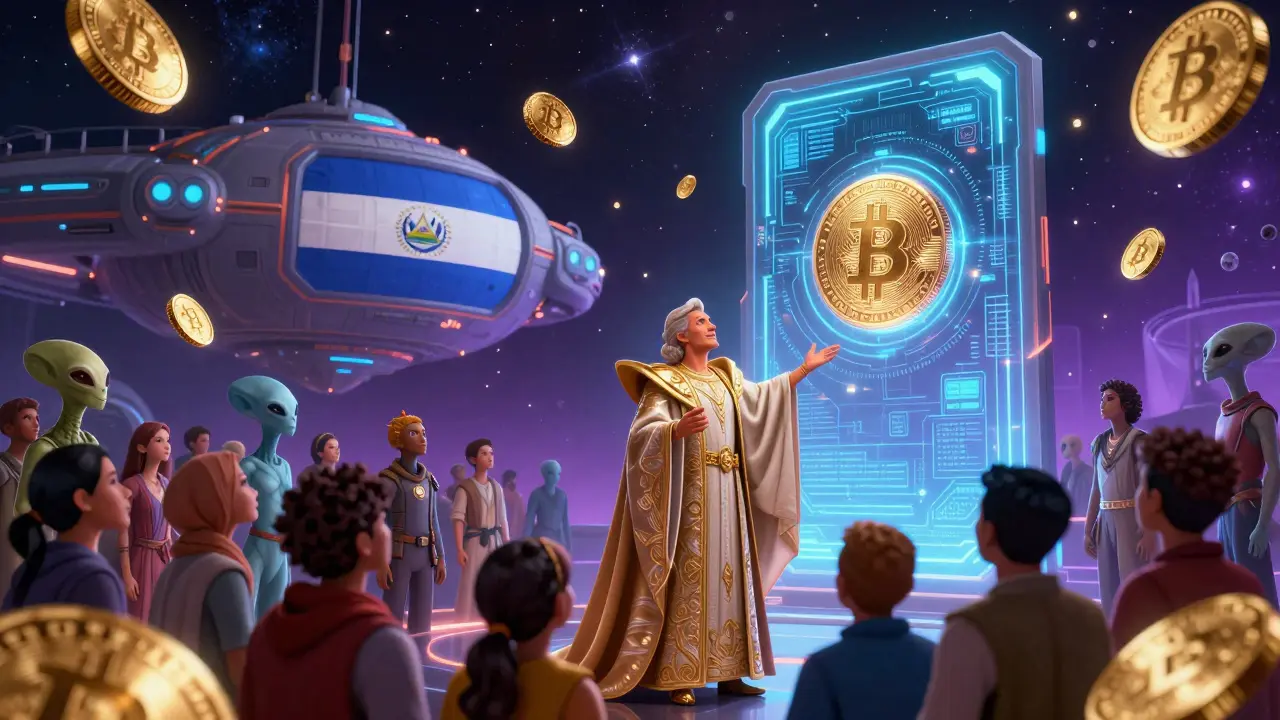
Imagine waking up and finding out your government just made a volatile digital asset the official currency of the land. That is exactly what happened in September 2021 when El Salvador became the first country to adopt Bitcoin is a decentralized digital currency that operates without a central bank or single administrator. It is the foundational asset for the entire cryptocurrency market. as legal tender. President Nayib Bukele didn't just want to follow a trend; he wanted to bypass traditional banks and give the 70% of Salvadorians who were "unbanked" a way to move money without paying high fees. But could a nation really replace the stability of the dollar with the wild swings of a digital coin?
The Big Bet: Why Bitcoin?
For years, El Salvador relied on the U.S. dollar, meaning they had zero control over their own monetary policy. By introducing Bitcoin, the government aimed to create economic sovereignty. The biggest practical goal was tackling remittances. Millions of Salvadorians living abroad send money home, usually losing a chunk of it to intermediaries like Western Union. A borderless digital asset promised a way to send money instantly and cheaply.
To make this work, the state launched Chivo Wallet is the official government-backed digital wallet designed to facilitate Bitcoin transactions and provide a basic financial tool for citizens. . The government even gave away a small amount of BTC to every citizen to get them started. On paper, it looked like a financial revolution. In reality, the transition from a cash-heavy society to a digital-first one proved to be a massive uphill battle.
The Gap Between Vision and Reality
If you walked through the streets of San Salvador in 2025, you would see Bitcoin logos everywhere. In fact, about 82% of small businesses accepted the coin. But here is the catch: just because a shop accepts Bitcoin doesn't mean people are actually using it. Data shows that only 1% of remittances actually flowed through the Chivo Wallet. Most people stuck to the dollar because they didn't want to risk their rent money on an asset that could drop 10% in value overnight.
Still, the infrastructure was a win. By 2022, more people had Bitcoin Lightning is a layer-2 payment protocol built on top of the Bitcoin blockchain to enable faster, cheaper micropayments. wallets than traditional bank accounts. This showed that while the El Salvador Bitcoin strategy had social friction, the technical plumbing was being installed.
| Feature | Traditional Banking | Bitcoin Strategy |
|---|---|---|
| Accessibility | ~30% of population had accounts | High (via digital wallets) |
| Transaction Cost | High fees for remittances | Near-zero (via Lightning Network) |
| Stability | Stable (USD peg) | High Volatility |
| Control | Dependent on U.S. Fed policy | Decentralized/Sovereign |

Pressure from the Global Financial Police
While Bukele was building "Bitcoin City" and dreaming of "Volcano Bonds," the International Monetary Fund is a global organization that works to foster global monetary cooperation and secure financial stability. Often called the IMF, it acts as a lender of last resort for countries in crisis (IMF) was not amused. The IMF viewed the adoption of Bitcoin as a threat to the country's financial stability and a risk to consumers.
This wasn't just a difference of opinion; it was a matter of money. The IMF tied a critical $1.4 billion financial assistance package to a specific condition: El Salvador had to stop treating Bitcoin as legal tender. For a government needing cash to keep the lights on, the pressure became too much. In January 2025, the government officially abolished Bitcoin's legal tender status. The mandatory requirement for businesses to accept BTC was gone.
The Pivot: From Currency to Reserve Asset
Does the removal of legal tender status mean the experiment failed? Not exactly. Instead of quitting, El Salvador shifted its strategy. They stopped trying to force the public to use Bitcoin for coffee and started treating it like digital gold. The government established the Strategic Bitcoin Reserve Fund is a national treasury account used to accumulate and hold Bitcoin as a long-term reserve asset to diversify national wealth. .
By March 2025, the treasury held 6,102 BTC, valued at roughly $500 million. Even after the IMF forced their hand on the legal tender law, the government kept buying. They realized that while Bitcoin might be too volatile for a grocery store transaction, it is a powerful asset for a national balance sheet. They moved from an "aggressive adoption" model to a "hybrid reserve" model.
Lessons Learned and the Road Ahead
Looking back, the experiment highlights a fundamental truth: technology cannot override human psychology. People value stability over innovation when it comes to their daily survival. The attempt to force adoption through law didn't work, but the attempt to build a tech-savvy image did. Events like the PLANB Forum 2025 prove that El Salvador still wants to be the "crypto hub" of Central America.
The country is now positioning itself as a place where blockchain companies can innovate without the heavy-handed restrictions found in the US or EU. They are no longer trying to replace the dollar, but they are using Blockchain is a distributed ledger technology that allows data to be stored across a network of computers, ensuring transparency and immutability to attract foreign investment and diversify their economy.
Is Bitcoin still legal in El Salvador?
Yes, it is legal to own and use Bitcoin in El Salvador. However, as of January 2025, it is no longer "legal tender," meaning businesses are no longer legally required to accept it as payment.
What happened to the Chivo Wallet?
The Chivo Wallet still exists, but its role has shifted from being a mandatory state tool to an optional service for those who want to use Bitcoin for private transactions.
Why did the IMF oppose the Bitcoin strategy?
The IMF was concerned about the extreme price volatility of Bitcoin, which could destabilize the national economy, and the risks it posed to financial integrity and consumer protection.
What are Volcano Bonds?
Volcano Bonds are proposed government bonds backed by Bitcoin, intended to fund the development of Bitcoin City using geothermal energy from the country's volcanoes.
Did the Bitcoin experiment fail?
Depending on who you ask. Economists from publications like The Economist call it a failure because it didn't achieve mass adoption. However, the government sees it as a success in terms of building a strategic reserve and attracting global tech attention.
Next Steps for Observers
If you are tracking this experiment, keep an eye on the total holdings of the Strategic Bitcoin Reserve Fund. If the government continues to accumulate despite IMF pressure, it signals a long-term belief in the asset as a hedge against inflation. For those interested in the tech side, watch for updates on Bitcoin City and how the country integrates geothermal energy with mining-this could be the next real-world test of sustainable blockchain infrastructure.


I'm a blockchain analyst and crypto educator who builds research-backed content for traders and newcomers. I publish deep dives on emerging coins, dissect exchange mechanics, and curate legitimate airdrop opportunities. Previously I led token economics at a fintech startup and now consult for Web3 projects. I turn complex on-chain data into clear, actionable insights.