You hold SOL, but you’re tired of locking it up for weeks just to earn a few percent in staking rewards. You want your money to work harder while you sleep, not sit idle in a validator queue. That’s exactly the problem BlazeStake Staked SOL, known as bSOL, was built to solve.
bSOL isn’t just another crypto coin. It is a liquid staking token that represents your staked SOL while letting you use that value elsewhere in the decentralized finance ecosystem. Think of it as a receipt for your deposited SOL that automatically grows in value over time, which you can also trade, lend, or swap instantly.
How bSOL Works: The Magic of Liquid Staking
To understand why bSOL matters, you first need to grasp the limitation of traditional staking. In standard proof-of-stake systems like Solana’s, when you delegate your SOL to a validator, those tokens are locked. They cannot be moved, sold, or used in other applications until you decide to unstake them-a process that can take days or even weeks depending on network congestion and epoch cycles.
Liquid staking changes this dynamic entirely. When you deposit SOL into the BlazeStake protocol, you receive bSOL tokens in return. These tokens are fully backed by real SOL held in reserve, plus the accumulated staking rewards. Here is what happens behind the scenes:
- Automatic Delegation: BlazeStake doesn’t send all your funds to one validator. Instead, it spreads your SOL across a diversified set of trusted validators. This reduces risk and supports Solana’s goal of network decentralization.
- Continuous Compounding: Every Solana epoch (roughly every two to three days), staking rewards are collected. Rather than paying these out separately, the protocol increases the amount of SOL backing each bSOL token. One bSOL today buys slightly more SOL than one bSOL did last month.
- Liquidity Retention: Because bSOL is a tradable token on the Solana blockchain, you can sell it, lend it, or use it as collateral without ever touching your original SOL position.
This mechanism creates a compounding effect. You don’t have to manually claim rewards and reinvest them. The appreciation happens automatically within the token itself. If you hold bSOL long-term, its exchange rate against SOL rises steadily, reflecting the yield earned by the underlying staked assets.
Why Use bSOL Instead of Regular Staking?
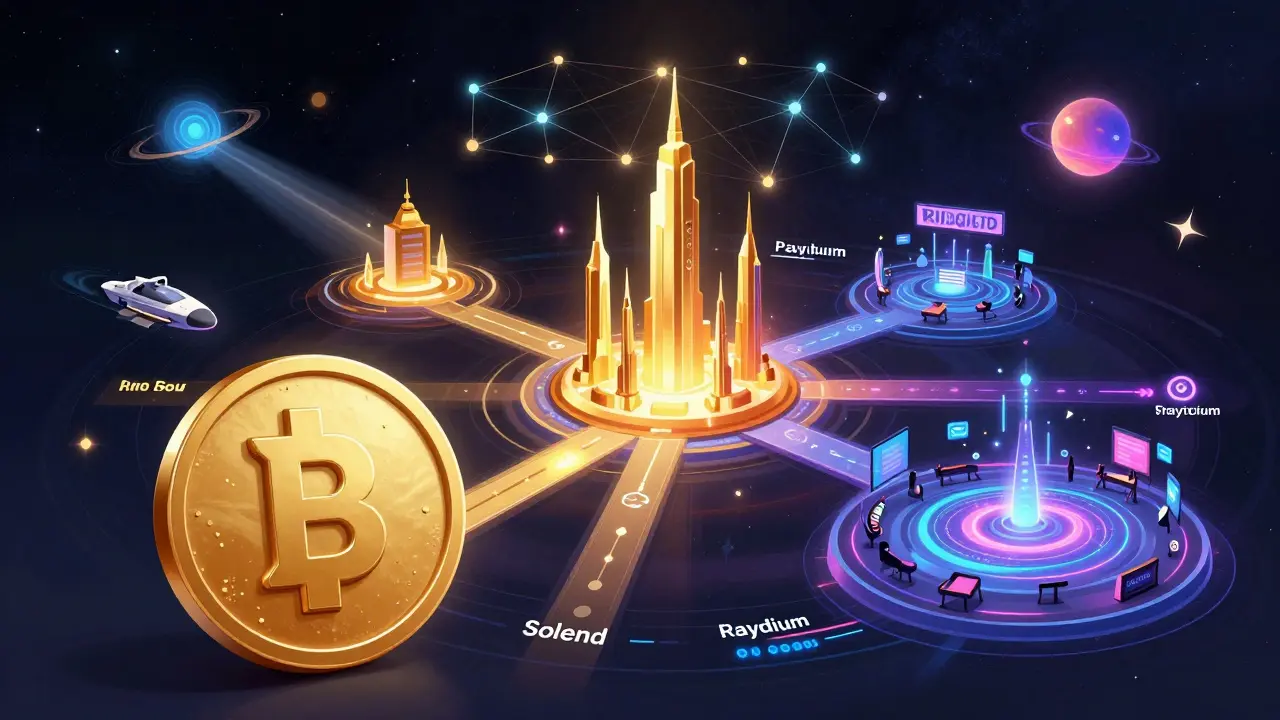
The main advantage of bSOL lies in capital efficiency. In traditional staking, your SOL is dead weight during the lock-up period. With bSOL, your capital remains active. You can deploy it into lending protocols like Solend or MarginFi, provide liquidity on decentralized exchanges such as Raydium, or simply hold it as a flexible store of value.
Consider this scenario: You have 100 SOL. If you stake directly, you earn roughly 6-7% annualized returns, but your funds are inaccessible. If you convert that 100 SOL to 100 bSOL, you still earn those same staking rewards through token appreciation. But now, you can lend those 100 bSOL on a DeFi platform to earn an additional 3-5% interest. Your total yield becomes additive rather than singular.
Furthermore, BlazeStake operates as a non-custodial solution supported by the Solana Foundation. This institutional backing provides a layer of credibility that independent staking pools often lack. The foundation’s involvement ensures alignment with Solana’s broader security and decentralization goals, reducing concerns about rogue operators or centralized control.
Buying and Trading bSOL: Where to Start
If you want to get your hands on bSOL, you have several options depending on your comfort level with decentralized tools. Most users begin by purchasing SOL on a centralized exchange like Coinbase, Kraken, or Binance, then transferring it to a self-custodial wallet such as Phantom or Solflare.
Once your SOL is in your wallet, you can swap it for bSOL using decentralized exchanges (DEXs) on the Solana network. Popular platforms include Raydium, Orca, and Jupiter Aggregator. The process is straightforward:
- Connect your wallet to the DEX interface.
- Select SOL as your input asset and bSOL as your output asset.
- Enter the amount you wish to convert.
- Review the slippage tolerance-usually 0.5% to 1% is sufficient for stable swaps.
- Confirm the transaction and pay the small Solana network fee.
The contract address for bSOL on Solana is bSo13r4TkiE4KumL71LsHTPpL2euBYLFx6h9HP3piy1. Always verify this address before executing any swaps to avoid sending funds to fake tokens. Scammers sometimes create lookalike contracts with similar names, so double-checking is critical.
For those who prefer centralized exchanges, some major platforms now list bSOL directly. However, availability varies by region and regulatory environment. Check local listings if you want to bypass the complexity of self-custody and DEX interactions.
Unstaking Options: Instant vs. Delayed
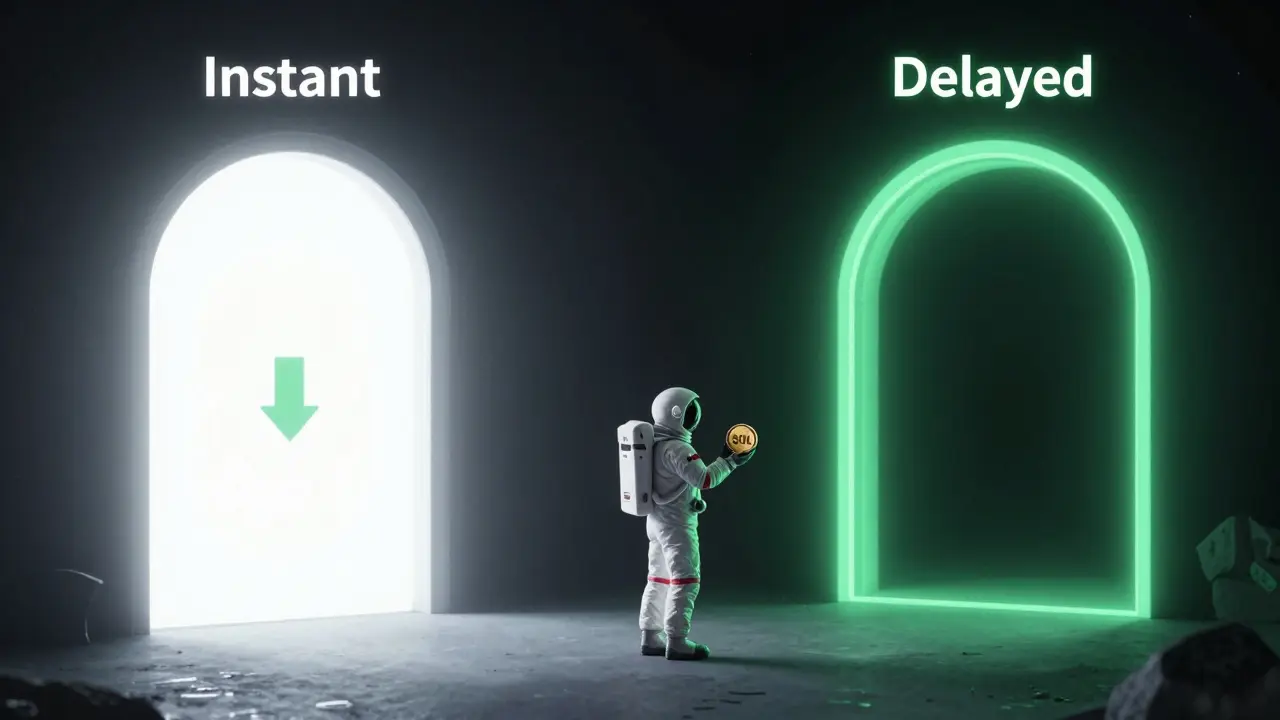
One of the most common questions new users ask is how to get their SOL back. BlazeStake offers two distinct paths, each with different trade-offs between speed and cost.
Instant Unstaking allows you to convert bSOL back to SOL immediately. This works through a secondary market where other users provide liquidity for quick exits. The catch? You pay a premium fee, which goes to the liquidity providers who enable this instant conversion. During periods of high demand or low liquidity, this fee can rise significantly. It’s ideal for emergency withdrawals or short-term trading strategies.
Delayed Unstaking is the cost-effective alternative. You submit an unstake request, and the protocol processes it over one or more epochs. There are no premium fees here, making it perfect for long-term holders who aren’t in a rush. Since Solana epochs last only two to three days, the wait is relatively short compared to other blockchains.
Choosing between these methods depends on your timeline. If you need cash flow tomorrow, pay the premium. If you’re rebalancing your portfolio next week, wait for the delayed exit to save on costs.
| Feature | Instant Unstaking | Delayed Unstaking |
|---|---|---|
| Speed | Immediate | 1+ Epochs (2-3 days) |
| Fees | Premium paid to liquidity providers | No premium; standard network gas only |
| Best For | Urgent liquidity needs | Cost-efficient exits |
| Risk | Higher slippage during volatility | Price movement during waiting period |
Risks and Considerations Before Investing
Like any financial instrument, bSOL carries risks that you must understand before committing capital. First, there is smart contract risk. Although BlazeStake has undergone audits and enjoys foundation support, no code is immune to bugs or exploits. Always keep only what you can afford to lose in any single protocol.
Second, consider impermanent loss if you provide bSOL liquidity on a DEX. If the price ratio between bSOL and SOL diverges sharply due to market shocks, you might end up with less value than if you had simply held the tokens statically. This is a standard DeFi risk, not unique to BlazeStake.
Third, remember that bSOL’s value is tied to SOL’s performance. If Solana’s price crashes, bSOL will follow suit, regardless of its internal yield accrual. Liquid staking enhances capital efficiency; it does not insulate you from broader market downturns.
Finally, tax implications vary by jurisdiction. In many countries, swapping SOL for bSOL may trigger a taxable event because it involves disposing of one asset and acquiring another. Consult a local tax professional to ensure compliance with reporting requirements.
The Future of bSOL in Solana’s Ecosystem
BlazeStake represents more than just a staking tool-it’s infrastructure. As Solana continues to grow its DeFi landscape, demand for liquid staking derivatives will increase. Developers building yield aggregators, lending markets, and cross-chain bridges rely on tokens like bSOL to provide deep, accessible liquidity.
The integration of bSOL into governance mechanisms also opens new possibilities. Token holders may eventually participate in DAO decisions related to validator selection, fee structures, or protocol upgrades. This aligns user incentives with network health, creating a more resilient ecosystem.
Moreover, the trend toward restaking-where staked assets are reused for multiple security layers-is gaining traction across blockchains. While Solana hasn’t fully adopted this model yet, bSOL positions itself as a foundational layer for future innovations. Its ability to compound yields passively while remaining liquid makes it a versatile primitive for next-generation financial products.
As institutional adoption of Solana accelerates, protocols with strong technical foundations and clear utility will stand out. BlazeStake’s endorsement by the Solana Foundation gives it a competitive edge over fragmented alternatives. Users seeking reliable, transparent, and efficient staking solutions increasingly turn to established players rather than experimental startups.
Is bSOL safe to hold?
bSOL is considered relatively safe due to its non-custodial design and backing by the Solana Foundation. However, all DeFi investments carry smart contract risk. Diversify your holdings and never invest more than you can afford to lose.
Can I lose money holding bSOL?
Yes. While bSOL appreciates relative to SOL over time, both tokens can drop in fiat value if the broader crypto market declines. Additionally, providing liquidity on DEXs exposes you to impermanent loss.
How do I convert bSOL back to SOL?
You can either use instant unstaking via a DEX (paying a premium fee) or delayed unstaking through the BlazeStake interface (waiting 1+ epochs with no extra fees). Choose based on urgency and cost preference.
Does bSOL earn passive income?
Yes. Each bSOL token represents an increasing amount of underlying SOL as staking rewards compound every epoch. Holders benefit from automatic yield accrual without manual claims.
Where can I buy bSOL?
You can acquire bSOL on decentralized exchanges like Raydium, Orca, or Jupiter by swapping SOL. Some centralized exchanges also list bSOL directly, though availability depends on your region.
What is the difference between bSOL and mSOL?
Both are liquid staking tokens on Solana, but they operate under different protocols. mSOL comes from Marinade Finance, while bSOL originates from BlazeStake. They differ in validator delegation strategies, fee structures, and DeFi integrations.
Is there a minimum amount to stake SOL for bSOL?
There is no strict minimum imposed by BlazeStake, but practical limits exist due to Solana’s rent exemption rules. Typically, you need at least 0.01 SOL to cover transaction fees and meet basic account thresholds.
I'm a blockchain analyst and crypto educator who builds research-backed content for traders and newcomers. I publish deep dives on emerging coins, dissect exchange mechanics, and curate legitimate airdrop opportunities. Previously I led token economics at a fintech startup and now consult for Web3 projects. I turn complex on-chain data into clear, actionable insights.