You see a coin called Vietnam Smarthub Logistics (VSL) on a price tracker, and you wonder: is this the next big thing in supply chain blockchain, or just another empty project? The short answer is that VSL is a highly specialized utility token designed for a specific logistics ecosystem in Vietnam, but it currently suffers from near-zero liquidity, confusing data across exchanges, and significant regulatory restrictions. If you are looking to trade it like Bitcoin or Ethereum, you will likely hit a wall. If you are a logistics provider inside their network, it might have value.
Let's cut through the noise. I've dug into the whitepaper, the contract address, and the live market data as of mid-2026 to give you the real picture of what this token actually does-and where it fails.
What Exactly Is VSL?
Vietnam Smarthub Logistics (VSL) is a BEP-20 cryptocurrency token built on the BNB Smart Chain (BSC), designed to serve as a medium for payment authentication and value exchange within a digital logistics ecosystem. It was launched around 2021-2022 (sources conflict here) with the goal of connecting 45 seaports, inland container depots, warehouses, and over 120 shipping lines globally.
The core idea isn't just "crypto for fun." The creators claim VSL solves a real headache in the shipping industry: messy, slow, and insecure payments between shippers, ports, and carriers. Instead of dealing with multiple bank transfers and currency conversions, the system uses VSL to authenticate transactions and convert service values instantly via smart contracts.
However, there is a catch. On its official site, the project explicitly states that VSL is not an investment asset and is not a lawful means of payment in Vietnam. This is crucial. Under Vietnamese law, private cryptocurrencies aren't legal tender. So, VSL is essentially a closed-loop utility token-like airline miles or loyalty points-but backed by blockchain technology instead of a corporate database.
Tokenomics: Supply, Distribution & Vesting
Understanding how many tokens exist and who holds them is vital before you risk any money. Here is the breakdown based on the project's whitepaper:
- Total Supply: 100,000,000 VSL (Fixed cap, no inflation).
- Circulating Supply: Reported as 0 VSL on major trackers like Binance, Coinbase, and Poloniex. CoinMarketCap lists 2,000,000 VSL, but this data is inconsistent and likely outdated or self-reported.
- Distribution:
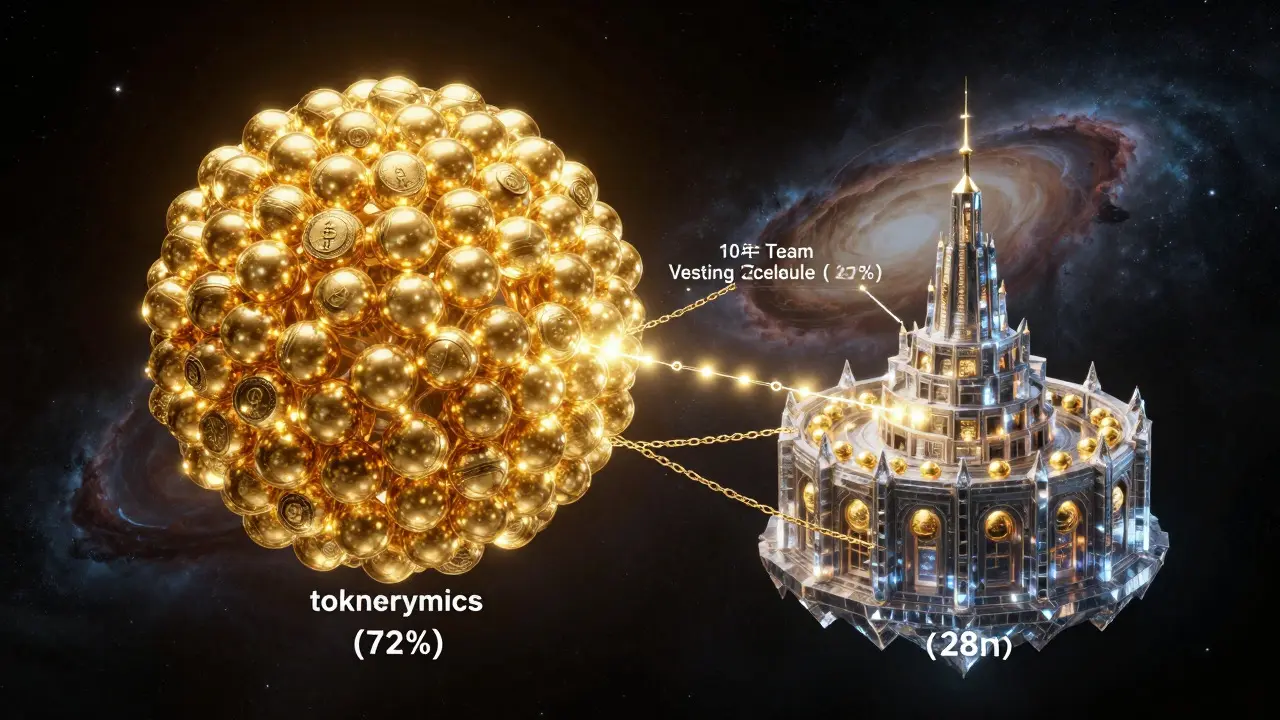
- 72% allocated to the community and ecosystem partners.
- 28% held by founders and the development team.
- Vesting Schedule: Tokens are released over a 10-year period. This means the majority of the supply is locked up, which reduces immediate sell pressure but also limits current liquidity.
The 28% team allocation is standard for early-stage projects, but because the circulating supply is so low (effectively zero on most platforms), the "fully diluted valuation" doesn't reflect reality. You can't buy 1 million VSL right now without moving the needle significantly, if you can buy any at all.
Technical Architecture: Where Does It Live?
This is where things get tricky for beginners. The VSL whitepaper and listings on Poloniex confirm that the token is a BEP-20 asset on the BNB Smart Chain (BSC). This means:
- You need a BSC-compatible wallet (like MetaMask configured for BSC or Trust Wallet).
- You need BNB (Ethereum's competitor on the BSC network) to pay for gas fees when sending or swapping VSL.
- The contract address published is
0x183289949a392b19F29F18f579bDd32CaCCa4a77.
Warning: Some aggregators like Coinpaprika incorrectly list VSL as running on the Ethereum blockchain. This is a critical error. If you try to send VSL to an Ethereum address or vice versa, you could lose your funds permanently. Always double-check that you are interacting with the BSC version of the token.
Market Reality: Price, Liquidity & Listings
If you check VSL on major exchanges, you will see a chaotic picture. As of mid-2026:
| Platform | Status | Price (USD) | 24h Volume | Circulating Supply |
|---|---|---|---|---|
| Binance | Not Listed / Tracked Only | $0.033 - $0.072 | $0 | 0 |
| Coinbase | Not Tradable | $0.089 | $856 | 0 |
| Poloniex | Listed (Low Activity) | $0.037 | $0.00 | 0 |
| PancakeSwap (DEX) | Active Pair (VSL/WBNB) | ~$0.04 - $0.09 | ~$39 | N/A |
| CoinMarketCap | Tracked | Varies | N/A | 2,000,000 (Self-reported) |
Notice the volumes? On PancakeSwap, the daily volume is often under $40. On Poloniex, it's $0. This means liquidity is extremely thin. If you try to buy $1,000 worth of VSL, you might slip the price by 20% or more because there aren't enough sellers in the order book. For a retail investor, this makes VSL nearly impossible to trade profitably in the short term.
The All-Time High (ATH) was $2.26, recorded during earlier hype cycles. The current price hovers between $0.03 and $0.09 depending on the data source. The gap between the ATH and current price highlights the speculative nature and lack of sustained demand.
Use Cases: Why Would Anyone Use VSL?
Despite the poor trading metrics, the token has defined utilities within its ecosystem. According to the whitepaper and platform docs, VSL is used for:
- Payment Authentication: Verifying invoices between shipping lines and port authorities without intermediaries.
- Value Conversion: Converting local currencies (like VND) into a standardized digital unit for international settlements within the app.
- Staking & Governance: Users can stake VSL to earn rewards or vote on ecosystem upgrades (though actual participation rates are unknown).
- AI Integration: The "Super Application" claims to use AI for predictive routing and logistics optimization, with VSL potentially serving as fuel for these computational services.
In theory, this is similar to how VeChain (VET) works for supply chain tracking. However, VeChain has billions in market cap and partnerships with Walmart and BMW. VSL is operating in a much smaller, localized niche with unproven adoption outside of its own stated network.

Risks & Red Flags
Before you connect your wallet, consider these risks:
- Regulatory Uncertainty: Since VSL is not legal tender in Vietnam and is labeled "not an investment," its legal standing is gray. If regulations tighten, the ecosystem could face hurdles.
- Data Inconsistencies: Conflicting launch years (2021 vs 2022), conflicting blockchains (BSC vs ETH), and conflicting supply numbers suggest poor communication or data management by the team.
- Liquidity Risk: With near-zero volume, exiting a position can be difficult. You might hold tokens you cannot sell without crashing the price.
- Centralization: 28% of the supply is held by the team. While vested, this concentration gives the developers significant control over the token's future direction and potential market impact.
- Lack of Independent Audits: There are no widely cited third-party security audits or enterprise case studies from major logistics firms. Most information comes from the project's own whitepaper and crypto aggregators.
How to Buy VSL (If You Still Want To)
Since VSL is not listed on major centralized exchanges like Binance or Coinbase for active trading, you will likely need to use a decentralized exchange (DEX). Here is the general process:
- Get a Wallet: Install MetaMask or Trust Wallet and configure it for the BNB Smart Chain (BSC).
- Buy BNB: Purchase BNB on a major exchange and transfer it to your wallet. You need BNB for gas fees.
- Go to PancakeSwap: Navigate to PancakeSwap V2 (the primary DEX on BSC).
- Add Custom Token: Paste the VSL contract address (
0x183289949a392b19F29F18f579bDd32CaCCa4a77) to import the token. - Swap: Swap BNB for VSL. Be aware of high slippage settings due to low liquidity.
Pro Tip: Always verify the contract address on the official VSL website before pasting it into your wallet. Scammers often create fake tokens with the same name but different addresses.
Final Thoughts
Vietnam Smarthub Logistics (VSL) is an ambitious attempt to digitize port and shipping payments using blockchain. The concept is sound, and the integration with AI and logistics networks has potential. However, as a crypto asset, it is currently immature. With negligible liquidity, conflicting data, and limited public adoption, it carries high risk for traders.
If you are part of the VSL logistics network, it may offer genuine utility for streamlining payments. If you are an external investor looking for quick gains, you might find better opportunities in more liquid, established assets. Treat VSL as a high-risk, experimental utility token rather than a mainstream investment.
Is VSL a safe investment?
VSL is considered high-risk due to low liquidity, regulatory uncertainties in Vietnam, and inconsistent market data. It is explicitly labeled as "not an investment asset" by its creators, meaning it lacks the protections and stability of traditional financial instruments.
Which blockchain does VSL run on?
VSL runs on the BNB Smart Chain (BSC) as a BEP-20 token. Although some aggregators incorrectly list it on Ethereum, the official whitepaper and contract address confirm it is a BSC-based asset. Always use the correct network to avoid losing funds.
Can I buy VSL on Binance or Coinbase?
No. As of mid-2026, VSL is not actively tradable on Binance or Coinbase. These platforms may track its price for reference, but they do not host active markets for VSL. You typically need to use decentralized exchanges like PancakeSwap to acquire the token.
What is the total supply of VSL?
The total fixed supply of VSL is 100,000,000 tokens. Of this, 72% is allocated to the community and ecosystem partners, while 28% is reserved for the founding team and developers, with a vesting schedule spanning 10 years.
Why is the circulating supply listed as 0 on some sites?
Many major trackers report 0 circulating supply because there is minimal active trading volume and limited verified distribution data. This reflects the token's nascent stage and lack of widespread public adoption, rather than a technical error in the token itself.


I'm a blockchain analyst and crypto educator who builds research-backed content for traders and newcomers. I publish deep dives on emerging coins, dissect exchange mechanics, and curate legitimate airdrop opportunities. Previously I led token economics at a fintech startup and now consult for Web3 projects. I turn complex on-chain data into clear, actionable insights.