There’s a crypto token called Nirvana NIRV (NIRV) that shows up on CoinMarketCap, Coinbase, and other price trackers - with a price of nearly $1. But here’s the twist: zero tokens are in circulation. No one owns them. No one is trading them. And yet, websites still list it as active.
What is Nirvana NIRV supposed to be?
Nirvana NIRV is a token built on the Solana blockchain, launched by a project called Soladex back in 2022. Its goal was to solve a real problem in DeFi: how to manage risk when you’re using stablecoins. Most stablecoins are pegged to the dollar, but if the reserve behind them collapses, you lose value. Nirvana’s idea was simple - bundle volatile assets (like SOL or ETH) with stablecoins into one token. That way, if the stablecoin drops, the volatile assets could cushion the blow. The token was meant to be called NIRV, and it was paired with two others: ANA and prANA.
The theory made sense. Solana’s fast, cheap network was the perfect place to build something like this. But theory doesn’t equal reality. And right now, Nirvana NIRV exists only as a line of code - not as a working asset.
The supply problem: 2 million or 26 million? Who knows?
One of the biggest red flags is the total supply. CoinMarketCap says there are 2,227,135 NIRV tokens ever created. Liquidity Finder says over 26 million. That’s more than a tenfold difference. Neither number is confirmed by the project team. No whitepaper update. No GitHub commit. No official statement.
But here’s the real issue: all platforms agree - 0 NIRV tokens are in circulation. That means not a single token has been distributed to any wallet. Not to early backers. Not to liquidity pools. Not to users. Nothing.
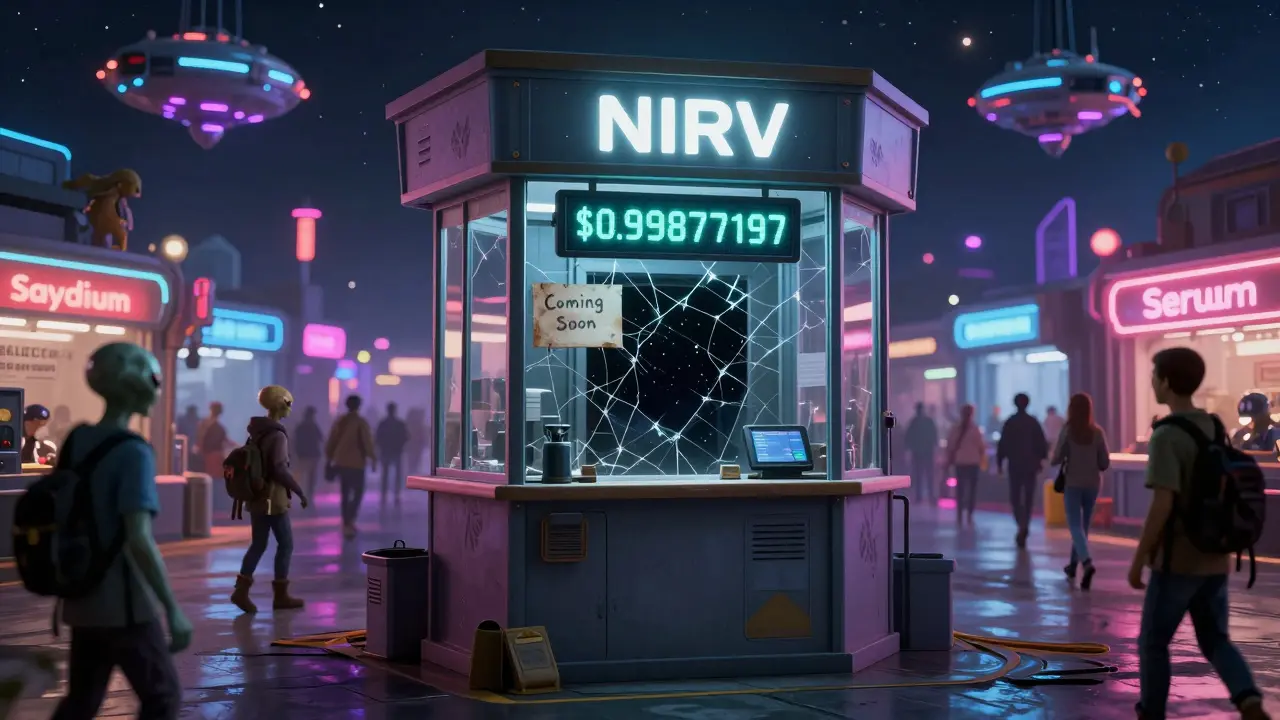
Think about that. If no one holds it, how can it have a price? How can it be ‘up 0.11% in 24 hours’ if nobody bought or sold it? Coinbase lists a price of $0.99877197, but also says $0.00 has been traded across all markets. That’s not a market. That’s a glitch.
Why does it still show up on exchanges?
Some crypto tokens get listed on trackers and exchanges even when they’re inactive. It’s not illegal - but it’s misleading. Platforms like CoinMarketCap and Coinbase pull data from public blockchain records and third-party feeds. If the smart contract exists and has a token symbol (NIRV), they’ll list it. They don’t verify if anyone’s actually using it.
Compare that to real Solana projects like Raydium or Serum. They have millions in TVL (total value locked), thousands of holders, and daily trading volume. NIRV has none of that. It’s like a store with a sign up, open hours posted, and prices on the shelf - but no products on the shelves, and no customers ever walking in.
No trading, no community, no updates
Check Reddit. Check Twitter. Check Telegram. There’s zero discussion about NIRV. No traders talking about buying or selling. No developers posting updates. No community events. No AMAs. The Soladex website hasn’t been updated since September 2022. That’s over three years of silence.
Even the ‘reviews’ section on Soladex is empty. No user feedback. No success stories. No complaints. That’s not normal. Even failed projects get attention - people post about losing money, or how they got scammed. With NIRV, there’s nothing. Not even a whisper.
And there’s no documentation on how to use it. No guides on how to buy NIRV. No wallet setup instructions. No explanation of how ANA or prANA work with NIRV. If you wanted to try this token today, you literally couldn’t. There’s no way to get it. No exchange lets you trade it. No DEX has liquidity. It’s a ghost.
How does it compare to other Solana tokens?
Solana has over 400 active DeFi projects as of 2025. Most of them have:
- Clear circulating supply numbers
- Regular on-chain activity
- Publicly audited smart contracts
- Trading volume above $10,000 per day
- Active developer teams
Nirvana NIRV has none of those. It doesn’t even meet the bare minimum. Even obscure Solana tokens like Bonk or Doge Killer have millions in trading volume and thousands of holders. NIRV? Zero. It’s not just behind - it’s not even on the track.
Is Nirvana NIRV a scam?
It’s not labeled as a scam by any watchdog. But it’s also not a working project. The combination of:
- Zero circulation with a live price
- Contradictory supply numbers
- No updates in over three years
- No community or trading activity
…is textbook abandoned project. Sometimes teams disappear after launch. Sometimes funding runs out. Sometimes the idea was never viable. Whatever happened, Nirvana NIRV is not alive.
It’s dangerous because new crypto users might see the $1 price and think, ‘This is cheap - I’ll buy now before it pumps.’ But you can’t buy it. You can’t store it. You can’t sell it. All you’re seeing is a data point on a screen - not a real asset.
Should you invest in Nirvana NIRV?
No. Not now. Not ever.
There’s no path to owning NIRV. No way to access it. No team to ask questions. No roadmap. No transparency. Even if the project came back tomorrow, you’d have to trust a team that vanished for three years with zero communication.
Real crypto investing means backing projects you can verify. You check the team. You look at the code. You see the transactions. You hear from users. With NIRV, you have none of that. What you have is a ghost in the machine - a token that looks real on a chart, but doesn’t exist in the real world.
What’s the bottom line?
Nirvana NIRV is a crypto token that was announced with a smart idea but never launched. It’s listed on major platforms because of technical automation - not because it’s functional. Its price is meaningless. Its supply is unverified. Its community is nonexistent. And its future is uncertain at best.
If you’re looking for real opportunities on Solana, there are dozens of active, transparent projects with real usage. Don’t waste time on NIRV. It’s not a hidden gem. It’s a dead end - with a price tag.


I'm a blockchain analyst and crypto educator who builds research-backed content for traders and newcomers. I publish deep dives on emerging coins, dissect exchange mechanics, and curate legitimate airdrop opportunities. Previously I led token economics at a fintech startup and now consult for Web3 projects. I turn complex on-chain data into clear, actionable insights.