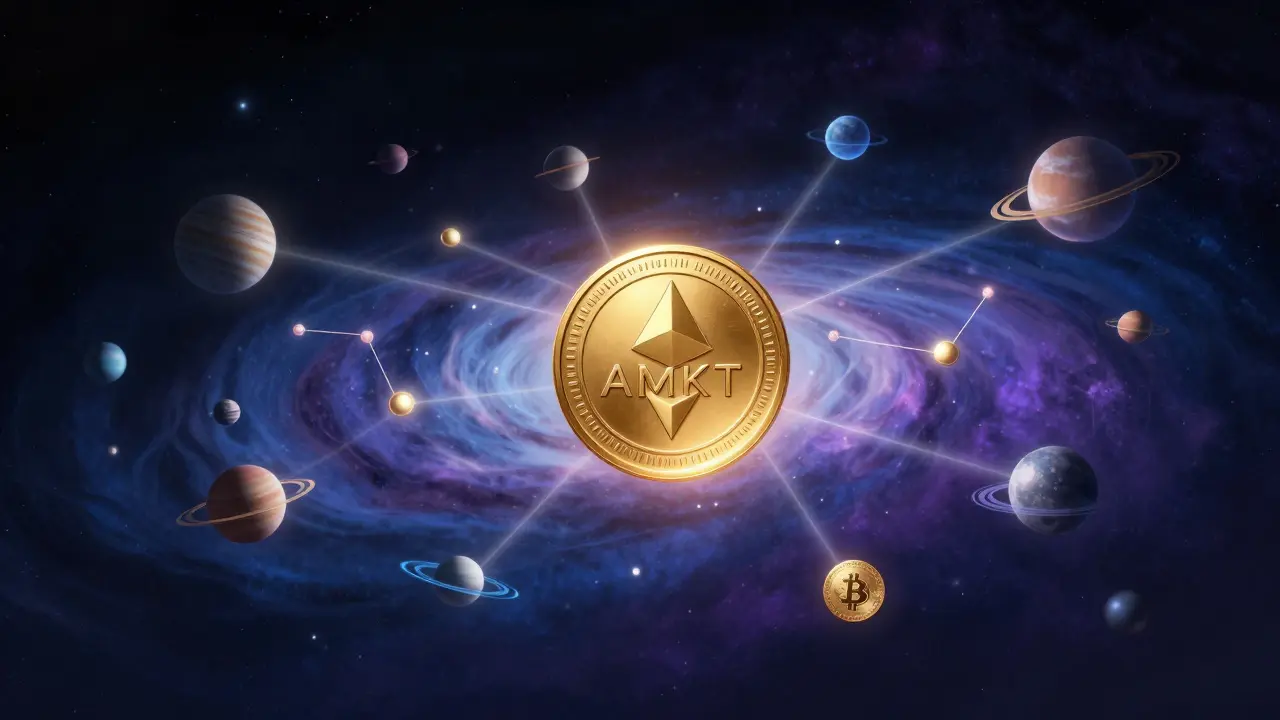
You want exposure to the broader cryptocurrency market without managing a dozen different wallets. You don't want to trade Bitcoin, Ethereum, Solana, and five others individually. You just want one asset that moves with the industry. That is exactly what Alongside Crypto Market Index promises.
AMKT is a cryptocurrency index token designed to passively track the overall movement of the broader crypto market through a single tradeable asset. Instead of buying twenty-five separate coins, you buy one AMKT token. The project claims this gives you simplified, diversified exposure to major digital assets. But does it actually work as advertised, or is it just another complex wrapper around volatile markets?
The Core Concept: A Single-Token Portfolio
Imagine the S&P 500 index fund in the traditional stock world. You buy one share of an ETF like SPY, and you own a slice of the 500 largest US companies. AMKT tries to replicate this model for crypto. It monitors 25 different crypto assets simultaneously. The weight of each coin in the basket is determined by its circulating supply market capitalization.
This means larger projects like Bitcoin or Ethereum naturally hold more weight than smaller altcoins. If the general crypto market rallies, AMKT should rise. If the market crashes, AMKT falls. The goal is pure passive tracking. There is no active manager trying to time the market or pick winners. This removes human error but also removes the chance for outperformance during specific sector rotations.
How AMKT Works: Rebalancing and Backing
The mechanics behind the scenes are critical for understanding risk. According to official documentation from Alongside, the token maintains continuous one-to-one backing. This means every AMKT token you hold is theoretically supported by an equivalent value in the underlying 25 crypto assets. It is not a leveraged derivative. It holds actual reserves.
However, holding assets isn't enough. Markets change. New coins launch, old ones fade. To keep the index accurate, AMKT uses a dual-schedule approach:
- Monthly Rebalancing: Adjusts weights to reflect current market compositions. This ensures the token accurately mirrors the live market cap data.
- Quarterly Reconstitution: A full review of the 25-asset basket. This accommodates significant structural changes, like adding a newly dominant token or removing one that has lost relevance.
This schedule aims to balance responsiveness with cost efficiency. Frequent trading burns money in fees. By limiting major shifts to quarterly events and minor tweaks to monthly cycles, the protocol minimizes slippage and transaction costs that could erode your returns.
Price Discrepancies and Liquidity Reality Check
Here is where things get tricky. If you look at price data across major exchanges as of mid-2026, you will see wild inconsistencies. This is a major red flag for any investor looking for stability.
| Exchange | Price (USD) | 24h Volume | Market Cap Estimate |
|---|---|---|---|
| Coinbase | $218.66 | $55.85K | $894.69K |
| Bybit | $290.32 | Low / Undefined | $1.00M |
| CoinMarketCap | $196.92 | $0 USD | $840.94K |
| Kraken | $160.43 | Not Specified | $351.52K |
| Crypto.com | $189.22 | N/A | N/A |
Look at that spread. On Kraken, AMKT trades at $160. On Bybit, it hits $290. That is an 81% difference for the exact same asset. Why does this happen? Two reasons: liquidity fragmentation and reporting lag.
AMKT is a small-cap asset. CoinMarketCap ranks it around position #6416 globally. Bybit places it between #3779 and #3953. These are deep-tier rankings. Most of the volume seems concentrated on Coinbase, which reported $55.85K in 24-hour volume. Other venues show near-zero activity. When liquidity is thin, even small trades can swing prices wildly. If you try to sell a large amount of AMKT on Kraken, you might crash the local price because there are few buyers waiting.

Risks and Missing Information
Before you allocate funds, consider what we don't know. The available public data reveals significant gaps that affect credibility.
- No Team Transparency: There are no official founder names or team member details publicly linked to the project. In crypto, reputation matters. Without knowing who built the smart contracts, assessing technical expertise is nearly impossible.
- Audit Status Unknown: Security audits are standard for tokens handling multi-asset baskets. No audit reports were found in public searches. For a token claiming one-to-one backing, unverified code is a high-risk factor.
- Regulatory Ambiguity: The regulatory status of AMKT is unspecified. Depending on your jurisdiction, an index token could be classified as a security. This affects which exchanges can list it and whether retail investors can legally hold it long-term.
- Liquidity Traps: The wide price variance suggests arbitrage opportunities exist but aren't being exploited efficiently. This often points to fragmented order books. You might buy at $218 on Coinbase but find you cannot sell at that price elsewhere.
AMKT vs. Traditional Diversification
Why would you choose AMKT over simply buying a basket of top 10 coins yourself? Convenience. Managing private keys for 25 assets is tedious. Tracking rebalancing manually requires constant attention. AMKT automates this.
However, compare this to established alternatives. Cryptocurrency Exchange-Traded Products (ETPs) or major index funds offer similar diversification with institutional-grade custody and transparency. AMKT operates in a niche space with lower adoption. Its all-time high was $363.29. Current prices hover roughly 40% below that peak. This depreciation indicates either a market correction or a loss of investor interest in this specific product structure.
If you are a beginner, AMKT simplifies entry. If you are an advanced trader, the lack of depth and transparency may outweigh the convenience. The passive index approach eliminates performance variance from active management, but it also locks you into the average market return, minus potential hidden costs from inefficient rebalancing.

Who Should Consider AMKT?
AMKT fits a very specific user profile. You should consider it if:
- You believe in the long-term growth of the entire crypto ecosystem, not just Bitcoin.
- You want hands-off diversification without setting up multiple wallets.
- You understand the risks of low-liquidity tokens and are comfortable trading primarily on Coinbase or other high-volume venues.
You should avoid it if:
- You need immediate liquidity for large positions.
- You require full transparency on the development team and smart contract audits.
- You prefer regulated investment vehicles like SEC-approved ETFs.
Final Thoughts on Market Position
Alongside Crypto Market Index addresses a real need. Investors crave simplicity. They want one ticker symbol to represent the "crypto bull run." AMKT delivers that mechanism. But execution is messy. The price discrepancies, low ranking, and missing foundational data create friction.
As of May 2026, AMKT remains a speculative instrument. It is not a blue-chip asset. Treat it as a tactical allocation within a broader portfolio, not a core holding. Monitor the liquidity on your chosen exchange carefully. If the gap between bid and ask prices widens, exiting your position could become expensive.
Is AMKT a safe investment?
Safety depends on your definition. AMKT is backed by actual crypto assets, which reduces counterparty risk compared to leveraged tokens. However, it carries high liquidity risk due to low trading volumes and significant price differences across exchanges. Additionally, the lack of public audit reports and team information adds uncertainty regarding smart contract security and operational integrity.
Which exchange is best for trading AMKT?
Based on available volume data, Coinbase appears to be the primary venue for AMKT trading, reporting $55.85K in 24-hour volume. Other platforms like Kraken and Bybit show significantly lower liquidity or undefined volumes. Trading on Coinbase likely offers better execution prices and reduced slippage, though you should always check the current order book depth before executing large trades.
How often does AMKT rebalance its holdings?
AMKT uses a dual-schedule system. Minor rebalancing occurs monthly to adjust weights based on current market capitalizations. A full reconstitution of the 25-asset basket happens quarterly. This allows the index to adapt to major market shifts while minimizing excessive trading fees associated with frequent adjustments.
What causes the price differences between exchanges?
The price disparities-ranging from $160 on Kraken to $290 on Bybit-are caused by liquidity fragmentation and asynchronous data reporting. Because AMKT is a low-volume asset, each exchange maintains its own isolated order book. Without sufficient arbitrage bots or high-frequency traders connecting these venues, prices diverge significantly based on local supply and demand dynamics.
Does AMKT charge management fees?
While specific fee structures were not detailed in the provided market data, index tokens typically incur costs related to rebalancing transactions and network gas fees. These costs are usually deducted from the underlying asset pool, effectively reducing the net asset value (NAV) per token over time. Investors should monitor the token's performance against the raw sum of its 25 constituents to gauge any drag from hidden fees.
Can I redeem AMKT for the underlying 25 coins directly?
Most index tokens like AMKT are designed to be traded on secondary markets rather than redeemed directly for constituent assets by retail users. Redemption mechanisms are often reserved for large institutional holders or automated market makers. For most investors, selling the AMKT token on an exchange is the only practical way to exit the position.
How does AMKT compare to Bitcoin dominance?
AMKT provides broad market exposure, whereas Bitcoin represents a single asset. When Bitcoin dominance rises, altcoins often underperform, causing AMKT to potentially lag behind BTC. Conversely, during "altseason" when smaller coins rally harder than Bitcoin, AMKT may outperform BTC. AMKT smooths out individual asset volatility but caps upside potential compared to picking winning altcoins.


I'm a blockchain analyst and crypto educator who builds research-backed content for traders and newcomers. I publish deep dives on emerging coins, dissect exchange mechanics, and curate legitimate airdrop opportunities. Previously I led token economics at a fintech startup and now consult for Web3 projects. I turn complex on-chain data into clear, actionable insights.