
Imagine a company with no CEO, no office, and no managers - yet it runs smoothly, makes decisions, and handles millions in funds. That’s what a DAO is in cryptocurrency. Short for Decentralized Autonomous Organization, a DAO is a group of people who use blockchain technology to make decisions together, without a central boss. Every rule, vote, and transaction is recorded publicly on a blockchain, so no one can cheat or hide anything. It’s not science fiction - it’s happening right now, with billions of dollars managed this way.
How Does a DAO Actually Work?
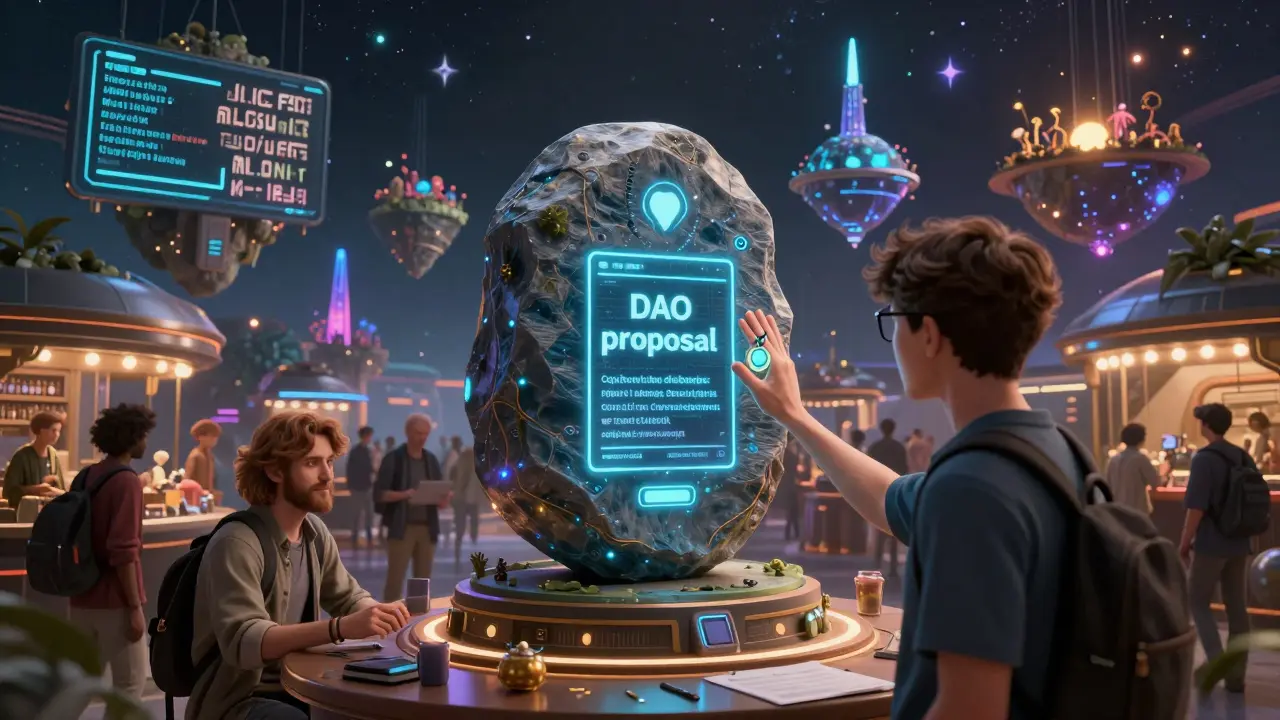
At its core, a DAO runs on smart contracts - self-executing code stored on a blockchain. These contracts are like digital rulebooks. Once they’re written and deployed, they can’t be changed unless the community votes to update them. That means no single person can steal funds, change rules, or shut things down. Everything is automatic and transparent.Members of a DAO usually hold governance tokens. These aren’t like Bitcoin or Ethereum - they’re not meant for spending. Instead, they give you voting power. The more tokens you hold, the more weight your vote carries. When a proposal comes up - say, spending $500,000 to fund a new app - everyone with tokens can vote. If enough people agree, the smart contract automatically releases the money. No bank approval. No paperwork. Just code doing what it was told.
Most DAOs run on Ethereum because it’s the most flexible for smart contracts. But others use Polygon, Solana, or even Bitcoin sidechains. Gas fees for voting can range from pennies to a few dollars, depending on network traffic. On Ethereum, a typical vote costs around $1.50. That’s cheap compared to hiring lawyers to draft contracts or paying platform fees to Kickstarter.
Why DAOs Were Created
Traditional companies are built on hierarchy. You have employees, managers, directors, and CEOs. Each layer adds delay, cost, and room for corruption. DAOs were designed to cut all that out. They’re built for trustless collaboration - meaning you don’t need to trust the people you’re working with. You just need to trust the code.Take ConstitutionDAO in 2021. A group of strangers from around the world pooled $47 million in just 72 hours to try and buy a rare copy of the U.S. Constitution. No company. No foundation. Just a Discord server, a smart contract, and thousands of small donations. They didn’t win the auction, but they showed what’s possible: global, instant, decentralized fundraising.
Another example is MakerDAO. It runs the DAI stablecoin - a cryptocurrency pegged to the U.S. dollar. Instead of a central bank setting interest rates, MakerDAO lets token holders vote on key parameters like the stability fee. In January 2024, 92% of voters turned out to approve a major rate change. That’s higher than most corporate board votes.
The Four Main Types of DAOs
Not all DAOs are the same. There are four big categories you’ll see in the wild:- Protocol DAOs - These manage decentralized finance (DeFi) platforms. Think Uniswap, Aave, or Compound. They decide how fees are set, which assets to support, and how to fix bugs. They make up over half of all DAOs.
- Investment DAOs - These pool money to invest in crypto projects. The LAO has funded 78 startups since 2020. Members vote on which projects get money, and if those projects succeed, everyone profits.
- Social DAOs - These are communities with shared culture. Friends With Benefits (FWB) has 5,000 members who pay $300 in crypto to join. They get access to events, Discord channels, and NFTs. It’s like a private club run by code.
- Philanthropy DAOs - These give money to open-source projects. GitcoinDAO has distributed over $50 million to developers since 2020 using a system called quadratic funding, which rewards smaller contributions more fairly.

The Dark Side: Problems With DAOs
DAOs sound perfect - until they break. The biggest failure was The DAO in 2016. It raised $150 million in Ether, then got hacked. Someone found a flaw in the code and drained $50 million worth of funds. The Ethereum community had to hard-fork the blockchain to get the money back. It was controversial, but it saved the ecosystem.Today, problems still exist:
- Voter apathy - Most DAOs have less than 15% of members voting. In 2023, one study found 68% of DAOs failed within 18 months because no one showed up to vote.
- Whale dominance - The top 10 token holders control over 51% of voting power in most major DAOs. That means a few rich wallets can override thousands of small ones.
- Slow decisions - A corporate board can approve a move in hours. A DAO takes 11 days on average. When Beanstalk Farms got hacked in 2022, the DAO couldn’t react fast enough. $182 million was lost.
- Legal gray zones - The SEC says many DAOs are unregistered securities offerings. In 2022, they fined The DAO’s creators $25 million. If your DAO raises money and promises returns, you might be breaking U.S. law.
How to Join a DAO
If you want to get involved, here’s how:- Buy governance tokens - Find a DAO you like (like Uniswap or Aave) and buy its token on a crypto exchange. For example, UNI (Uniswap’s token) was trading at $4.87 in December 2025.
- Connect your wallet - Use MetaMask or Ledger to link your crypto wallet to the DAO’s voting platform (like Snapshot or Tally).
- Vote on proposals - Read the proposal. Check the voting period. Cast your vote. Most DAOs require a minimum of 20-30% participation to be valid.
- Contribute - Some DAOs let you earn tokens by doing work - writing docs, moderating Discord, or coding. GitcoinDAO pays developers in ETH for open-source contributions.
Learning the ropes takes time. The average new member spends 17 hours just to understand how to vote. Many get stuck on gas fees or wallet setup. But once you get past that, you’re part of a global network of decision-makers.
What’s Next for DAOs?
DAOs are still young. But big changes are coming:- SubDAOs - Large DAOs are creating smaller teams. Aave’s Lens Protocol subDAO handles its social media features. This lets people focus on one area without being overwhelmed.
- Delegated voting - Instead of voting on every proposal, you can assign your vote to someone you trust. Curve Finance’s veCRV system boosted participation by 220%.
- Legal wrappers - Some DAOs now form LLCs in Wyoming or Singapore to comply with local laws. Over 30% of top DAOs have done this.
- Institutional adoption - BlackRock filed to launch a DAO-managed tokenized fund in late 2024. Fidelity started a DAO research team in January 2025. Big finance is watching.
The biggest question hanging over DAOs is regulation. The SEC’s new framework is expected in Q2 2026. Will they treat DAOs as companies? As cooperatives? Or as illegal securities? That decision could make or break the entire movement.
Final Thoughts
DAOs aren’t magic. They’re not always efficient. They’re not always fair. But they’re the first real attempt to build organizations without power centers - where trust is built into the system, not begged for from leaders. They’ve funded projects, protected open-source code, and given ordinary people a voice in global finance.If you’re curious, start small. Join a social DAO. Vote on one proposal. See how it feels to be part of a digital town hall. You might not change the world. But you’ll understand how the next wave of organizations is being built - one vote at a time.
What is a DAO in cryptocurrency?
A DAO, or Decentralized Autonomous Organization, is a group that operates without central leadership. It’s governed by rules encoded in smart contracts on a blockchain. Members vote on decisions using governance tokens, and all actions - like spending funds or changing rules - are automatically executed based on those votes. There’s no CEO, no board, and no paperwork - just transparent, community-driven control.
How do DAOs make decisions?
DAOs make decisions through voting. Members hold governance tokens, and each token usually represents one vote. When a proposal is submitted - like spending treasury funds or updating code - members vote over a set period (usually 7-14 days). If the proposal hits a threshold (like 50% approval and 25% voter turnout), the smart contract automatically carries it out. Everything is recorded on the blockchain for anyone to see.
Can you lose money in a DAO?
Yes. DAOs can lose money through smart contract bugs, hacks, or poor decisions. The DAO hack in 2016 stole $50 million. In 2022, Beanstalk Farms lost $182 million because its DAO couldn’t respond fast enough to a hack. Even without hacks, if too few people vote, bad proposals can pass. Your tokens can also lose value if the DAO fails or the market turns.
Are DAOs legal?
It depends. In the U.S., the SEC has said many DAOs operate as unregistered securities offerings, which is illegal. Wyoming passed a law in 2021 recognizing DAO LLCs, giving them some legal protection. The EU’s MiCA rules treat DAO tokens as utility tokens unless they promise profits. Most DAOs operate in a legal gray zone. If your DAO raises money and promises returns, you’re likely at risk.
Do you need crypto to join a DAO?
Usually, yes. Most DAOs require you to hold their governance token to vote. You can buy tokens on exchanges like Coinbase or Uniswap. Some DAOs let you earn tokens by contributing work - like writing code, translating docs, or moderating forums. But you’ll still need a crypto wallet (like MetaMask) and some ETH or MATIC to pay for gas fees when voting.
What’s the difference between a DAO and a traditional company?
A traditional company has a CEO, managers, and a hierarchy. Decisions go up the chain and are made at the top. A DAO has no hierarchy - everyone with tokens can vote. No one owns the DAO. No one can fire anyone. Rules are enforced by code, not lawyers. DAOs are slower but more transparent. Companies are faster but less open. DAOs are global. Companies are often tied to one country’s laws.
How much money do DAOs manage?
As of late 2023, DAOs collectively manage over $21 billion in assets, according to DeepDAO. This includes everything from DeFi protocols like Uniswap to investment funds like The LAO. That’s up from just $500 million in 2020. But it’s still less than 0.5% of the total value of all public companies worldwide.
Can a DAO be hacked?
Yes - and it’s one of the biggest risks. Since DAOs run on code, if there’s a bug in the smart contract, hackers can exploit it. The DAO hack in 2016 stole $50 million. In 2023, over $2.1 billion was lost to smart contract exploits across all DAOs. That’s why many DAOs use multi-signature wallets (requiring 3-5 of 7+ people to approve transactions) and time delays before spending. Still, no system is perfect.


I'm a blockchain analyst and crypto educator who builds research-backed content for traders and newcomers. I publish deep dives on emerging coins, dissect exchange mechanics, and curate legitimate airdrop opportunities. Previously I led token economics at a fintech startup and now consult for Web3 projects. I turn complex on-chain data into clear, actionable insights.