
XRPH Price Comparison Tool
The article highlights significant price differences between exchanges. This tool helps you understand how much you'd get based on current exchange rates. Note: XRPH has extremely low liquidity, so these differences could change rapidly.
Price Comparison
Most people hear "crypto" and think Bitcoin or Ethereum. But there are hundreds of tokens built for specific industries - and XRP Healthcare (XRPH) is one of them. It’s not just another altcoin. It’s designed to move money across borders for medical services and drug shipments, especially in places where banking systems are weak or slow. If you’ve ever wondered how a crypto token can actually help real people get medicine, XRPH is a case study in ambition - and risk.
What XRPH Actually Does
XRP Healthcare (XRPH) isn’t a payment app you download. It’s a token built on the XRP Ledger, a blockchain known for fast, cheap transactions. Its job? To let hospitals, clinics, and pharmacies in Africa and beyond pay for medicines, equipment, or services without waiting days for bank wires or paying high fees. Think of it like digital cash for global healthcare logistics.
Unlike tokens that just trade on exchanges, XRPH is tied to a real business: XRP Healthcare M&A Holding Inc., a Dubai-based company buying up pharmacy chains across Africa. They’ve already completed their first major acquisition - a retail and wholesale pharmacy network - and plan to keep expanding. The idea is simple: use blockchain to streamline payments, and use physical pharmacies to deliver care. The token is meant to be the glue between the two.
How the Token Works (And Doesn’t)
Here’s where things get tricky. The company behind the token - XRP Healthcare LLC - says it doesn’t control or benefit from XRPH. Instead, the token is managed separately from the healthcare acquisitions. That means when the company buys a pharmacy in Nigeria, it doesn’t use XRPH tokens to pay for it. The token exists on its own, traded on exchanges like BitMart and MEXC.
So why does the token exist at all? The company claims it will eventually power payments within its own network - like paying for prescriptions or shipping drugs between its owned pharmacies. But right now, there’s no public proof that XRPH is actually being used in any real transaction. No live integrations. No API documentation. No reports from clinics using it. The token’s utility is still theoretical.
Price and Trading Reality
As of October 31, 2025, XRPH trades around $0.04014 on CoinMarketCap. But look closer, and you’ll see wild differences. On BitMart, it’s listed at $0.061 - nearly 50% higher. Why? Because each exchange sets its own price based on who’s buying and selling. That’s normal for small tokens, but it’s a red flag for anyone looking for stable value.
The 24-hour trading volume is just over half a million dollars. That’s tiny compared to major coins. BitMart and MEXC together handle 93% of all trading. If one of them goes down or freezes withdrawals, XRPH’s price could crash overnight. There’s no deep order book - a $10,000 buy order could push the price up 10% in minutes. This isn’t investing. It’s speculation.
Price predictions range from $0.0018 to $0.17 by 2030. That’s a 10,000% difference. No analyst has a clear method behind these numbers. They’re mostly guesses based on hype, not data. Even the technical indicators on Investing.com show up as "NaN" - meaning there’s not enough historical data to calculate them. That’s not a sign of strength. It’s a sign of inactivity.

Why It’s Not Like Other Healthcare Tokens
There are other crypto projects trying to fix healthcare. Solve.Care lets patients pay for services using tokens. MediBloc lets you own your medical records on blockchain. Both focus on software and data.
XRPH is different. It’s not building a protocol. It’s buying pharmacies. That’s a huge shift. Most crypto projects fail because they can’t execute. XRPH is trying to do something even harder: run a real business in multiple African countries, with complex regulations, supply chains, and staffing - while also managing a cryptocurrency.
That’s a double burden. If the pharmacy acquisitions fail, the token loses its story. If the token crashes, the company loses its funding tool. There’s no safety net. And unlike Bitcoin, where value comes from network adoption, XRPH’s value depends entirely on whether a Dubai company can successfully run a chain of African pharmacies.
The Big Question: Is This a Token or a Stock?
Here’s the most confusing part: XRP Healthcare M&A Holding Inc. announced plans to go public. That’s unheard of for a crypto project. Most tokens stay on exchanges. This one might become a regular stock on a stock market.
But what happens to XRPH holders then? Will they get shares? Will the token keep trading? Will it be delisted? No one says. The company’s website makes it clear they don’t control the token - but they also don’t explain how token holders benefit if the company goes public. That’s a massive gap. You can’t invest in something when you don’t know what you’re investing in.
What’s Missing: The Red Flags
For any crypto project, you need to know:
- How many tokens exist?
- Who owns them?
- Are they being locked up or sold off?
- Is there a burn mechanism?
- Can holders vote on decisions?
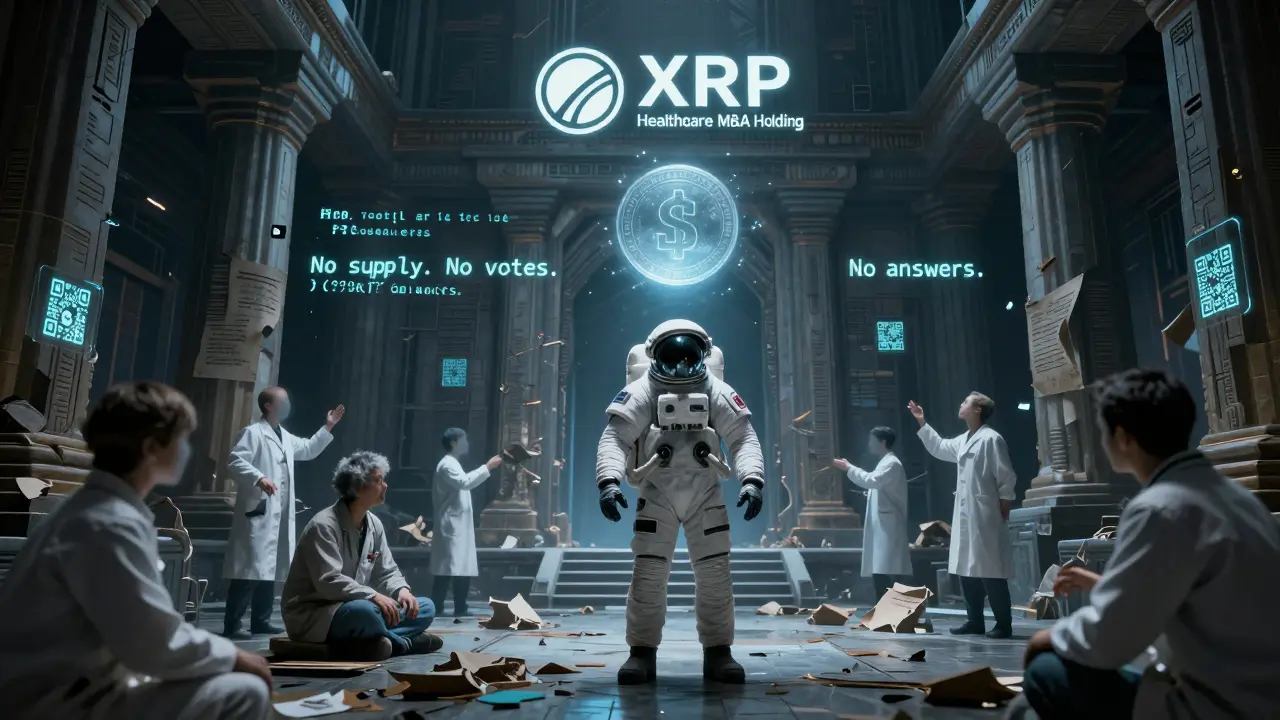
For XRPH? No answers. Zero public documentation on tokenomics. No whitepaper. No GitHub. No community forums. No developer updates. You can’t find a single Reddit thread discussing XRPH in depth. That’s not normal. Even the smallest successful crypto projects have active communities and transparent code.
And then there’s regulation. The company operates in Dubai, buys pharmacies in Africa, and trades on global exchanges. That’s three legal systems. Healthcare has strict rules about licensing, drug distribution, and patient data. Crypto has rules about securities, money laundering, and disclosures. No one says if they’ve gotten any licenses. No one says if they’re compliant. That’s a huge risk.
Should You Buy XRPH?
If you’re looking for a safe, long-term crypto investment - skip it. This isn’t Bitcoin. It’s not even Ethereum. It’s a high-risk bet on a company’s ability to execute a complex, multi-country business plan while managing a token with no clear utility.
If you’re a speculator who likes volatile, low-volume coins with big price swings - then maybe you’ll see a short-term pop. The 30-day gain of 30.6% looks tempting. But remember: that kind of surge often comes from pump-and-dump schemes. The volume is too low. The liquidity is too thin. The information is too scarce.
Real utility? Not yet. Real transparency? Not close. Real business progress? Maybe - but it’s buried in a magazine they published, not in public reports.
Until XRP Healthcare releases a clear tokenomics document, shows real usage of XRPH in their pharmacies, and explains how token holders fit into their public listing plans - this remains a mystery wrapped in a risky bet.
Final Take
XRP Healthcare (XRPH) isn’t a scam. It’s not a Ponzi. It’s a company trying to do something ambitious: fix healthcare access in Africa using blockchain as a payment tool. But the token itself is disconnected from the business. The data is missing. The roadmap is vague. And the price? Pure speculation.
It’s a reminder that not every coin with a "healthcare" label is a solution. Some are just names slapped onto a token to attract buyers. If you’re interested in healthcare crypto, look at projects with open code, active developers, and clear utility. XRPH doesn’t meet that bar - yet.
Is XRP Healthcare (XRPH) the same as XRP (Ripple)?
No. XRP is the native cryptocurrency of the XRP Ledger, created by Ripple Labs. XRPH is a separate token built on the same blockchain, but it’s managed by a completely different company focused on healthcare acquisitions in Africa. They share the same technology foundation, but no business or ownership ties.
Can I use XRPH to pay for medicine right now?
There is no public evidence that XRPH is used to pay for medicine or services. While the company says it plans to integrate the token into its pharmacy network, no clinics, pharmacies, or patients have been documented using it. The token currently exists only as a tradable asset on exchanges.
Why is the price so different on different exchanges?
XRPH has low trading volume and thin order books. With only $526K traded in 24 hours and 93% of volume concentrated on two exchanges, small buy or sell orders can move the price significantly. Each exchange sets its own price based on local demand, leading to large gaps between platforms like BitMart and MEXC.
What happens to XRPH if the company goes public?
It’s unclear. The company says it doesn’t control the token, and there’s no official statement on whether token holders will get shares, retain their tokens, or see the token delisted. This lack of clarity creates major uncertainty for anyone holding XRPH, as the token’s value could become disconnected from the company’s equity.
Is XRPH a good long-term investment?
Not based on current information. The token lacks transparency in supply, distribution, governance, and utility. Its value is tied to a business model that’s still unproven and operating in high-risk markets. Without clear documentation or real-world usage, it’s speculative at best and potentially high-risk at worst.


I'm a blockchain analyst and crypto educator who builds research-backed content for traders and newcomers. I publish deep dives on emerging coins, dissect exchange mechanics, and curate legitimate airdrop opportunities. Previously I led token economics at a fintech startup and now consult for Web3 projects. I turn complex on-chain data into clear, actionable insights.