The Hard No: Completely Blocked Countries
Some regions are completely off-limits. If you're in a country subject to heavy international sanctions, Kraken won't let you open an account, period. This isn't just a company policy; it's often a legal requirement to prevent money laundering and terrorism financing. Currently, Kraken enforces complete service prohibitions in several nations. These include high-profile sanctioned areas like Russia (including Crimea, Donetsk, and Luhansk), Iran, North Korea, and Syria. Other blocked jurisdictions include Afghanistan, Belarus, Iraq, Libya, Sudan, South Sudan, and Cuba. Beyond the most famous sanctions, there's a second tier of restricted territories. You'll find the Central African Republic, Congo-Brazzaville, Eritrea, Congo-Kinshasa, Guinea-Bissau, Lebanon, Mali, Namibia, Somalia, Tajikistan, and Yemen on the restricted list. If you're located here, your IP address will likely trigger a block immediately upon visiting the site.United States: A Patchwork of Restrictions
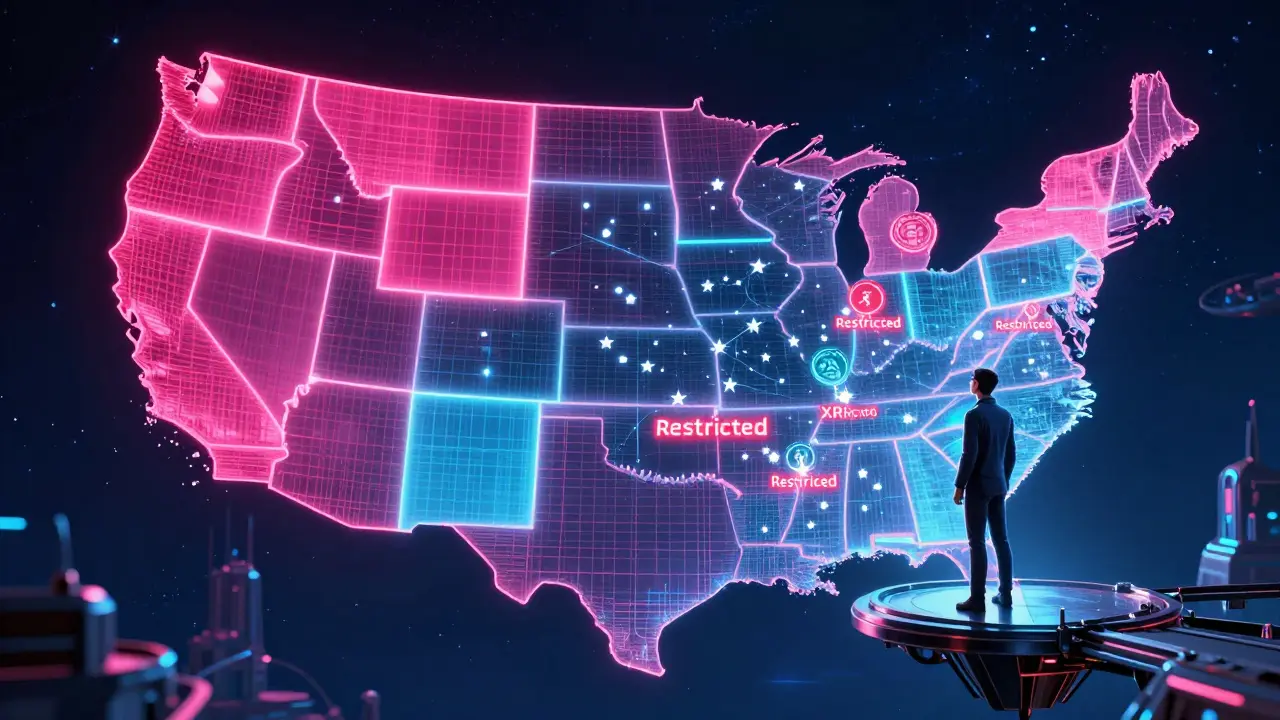
Living in the US doesn't mean you have a green light for every feature. Because the US treats crypto regulation state-by-state, Kraken has to apply granular restrictions. This creates a confusing experience where your neighbor in a different state might have access to a coin that you don't. For example, residents of New York and Washington State face the steepest hurdles. In many cases, these users are completely excluded or can only apply for pre-verification while waiting for regulatory approval. Even if you're in a "friendly" state, you'll notice that XRP trading is prohibited across all US states. Then there are the currency-specific quirks. If you live in Texas or New Hampshire, you can't fund, trade, or hold Euros. If you're looking for EWT or GRT tokens, those are blocked for both US and Canadian residents. Even Ethereum has a twist: ETH2.S is limited to staking only, meaning you can't trade it directly. To make things more complex, US traders face tighter leash on margin trading. While a non-US trader might hold a margin position for 365 days, US residents are capped at 28 days. This is a direct result of the exchange's effort to avoid the kind of heat they took during their 2021 settlement with the CFTC over margin violations.The European Shift: MiCA and Stablecoin Chaos
Europe used to be a stronghold for Kraken, but the introduction of the MiCA is the Markets in Crypto-Assets regulation, a comprehensive framework designed to standardize crypto rules across the European Union has changed the game. In early 2025, Kraken had to make a massive pivot regarding stablecoins to stay compliant. This resulted in a phased delisting of five major stablecoins: Tether (USDT), PayPal USD, TrueUSD, Tether EURt, and TerraClassic USD. This move hit over 30 countries, including Spain, Portugal, Sweden, and Austria.| Date | Status/Phase | Action Allowed |
|---|---|---|
| February 13, 2025 | Reduce-only mode | Close or reduce positions only |
| February 27, 2025 | Sell-only mode | Sell existing assets, no buying |
| March 17, 2025 | Margin closure | All margin positions forcibly closed |
| March 24, 2025 | Spot termination | All spot trading for these coins ended |
| March 31, 2025 | Final Conversion | Remaining balances converted |
Global Nuances: Australia and Japan
Kraken's compliance doesn't stop at the US and EU. They maintain specific licenses like those from AUSTRAC in Australia and the FSA in Japan. In Australia, the focus is on privacy. Residents are blocked from funding, trading, or holding "privacy coins" such as Monero (XMR), Zcash (ZEC), or DASH. This aligns with broader Australian regulatory trends that view anonymous transactions as a high risk for illicit activity. Japanese users have a different set of hurdles. While they can access the platform, they must adhere to strict documentation standards specifically for JPY currency trading. It's less about "blocking" and more about "extreme vetting."How Kraken Actually Blocks You
You might wonder if a VPN is a quick fix. In short: don't try it. Kraken uses a multi-layered verification system that is much harder to fool than a basic website. First, they use IP geolocation to see where you are. But the real wall is the KYC is Know Your Customer, a mandatory process of verifying a client's identity to prevent fraud and illegal activities process. You have to provide government-issued ID and proof of residence (like a utility bill). If your ID says you're from a blocked jurisdiction, the account is flagged instantly. Kraken also monitors transactions. If you're using a verified account but suddenly start moving funds in a way that suggests you've relocated to a restricted zone, they can freeze your assets. Using a VPN to spoof your location often leads to immediate account termination and a permanent freeze of funds, as their detection systems are designed to spot geographic spoofing.
The Cost of Compliance
From a business perspective, being the "good student" comes with a price. By following every rule, Kraken loses market share to smaller, less compliant exchanges that allow users in blocked regions to trade without ID. However, this strategy is a long-term play. By securing a Special Purpose Depository Institution (SPDI) charter in Wyoming-the first for any crypto exchange-Kraken has built a bridge to traditional banking that most of its competitors lack. They are positioning themselves for the day when institutional money (big banks and hedge funds) enters the market en masse. Those players won't touch an exchange that ignores sanctions or skips KYC.What's Next for Restricted Users?
If you're currently blocked, there are a few things to watch for. Kraken is still pursuing regulatory approval in New York and Washington, so those states might eventually see a full rollout. There's also hope that as the SEC clarifies its stance on staking, some of the limited-function assets (like ETH2.S) might become fully tradable again. For those in the EU, the evolution of MiCA will likely bring more changes to which stablecoins are allowed. The current volatility in available assets is just the first wave of a broader shift toward "regulated" stablecoins that are backed by audited reserves.Can I use a VPN to access Kraken from a blocked country?
It is strongly discouraged. Kraken uses sophisticated detection for geographic spoofing. Even if a VPN gets you onto the site, you cannot bypass the KYC (Know Your Customer) process which requires a government ID and proof of residence. If caught, Kraken typically terminates the account and freezes all assets.
Why can't I trade XRP if I live in the US?
This is due to the ongoing regulatory and legal environment surrounding XRP in the United States. To avoid legal conflict with US regulators, Kraken has disabled XRP trading for all US-based accounts.
Which stablecoins were removed for European users?
Following MiCA regulations, Kraken delisted Tether (USDT), PayPal USD, TrueUSD, Tether EURt, and TerraClassic USD for users in over 30 European countries, including Spain and Sweden.
Are there specific restrictions for Australian users?
Yes. Australian residents are prohibited from funding, trading, or holding privacy-focused cryptocurrencies, specifically Monero (XMR), Zcash (ZEC), and DASH.
What happens if I move to a blocked jurisdiction?
If you relocate to a restricted area, you are generally required to notify the exchange or close your positions. Kraken's ongoing monitoring of IP addresses and transaction patterns may trigger an account review, which could lead to a restriction of services if you are found to be residing in a blocked region.


I'm a blockchain analyst and crypto educator who builds research-backed content for traders and newcomers. I publish deep dives on emerging coins, dissect exchange mechanics, and curate legitimate airdrop opportunities. Previously I led token economics at a fintech startup and now consult for Web3 projects. I turn complex on-chain data into clear, actionable insights.