Pakistan’s Crypto Mining Rules Just Changed - Here’s How
In 2025, Pakistan went from blocking crypto mining to actively inviting it. After years of confusion, where the central bank said cryptocurrencies were illegal but local crypto groups pushed for adoption, the government finally made a clear move. The Virtual Assets Act, 2025 didn’t just legalize mining - it created a full regulatory system to manage it. This isn’t a loophole or a temporary fix. It’s a national strategy.
Before this law, miners operated in the shadows. Some used home electricity, others ran rigs in warehouses without permits. Now, if you’re mining Bitcoin or any other cryptocurrency in Pakistan, you need a license from the new Pakistan Virtual Asset Regulatory Authority (PVARA)The federal body established in July 2025 to regulate all virtual asset activities including mining, trading, and staking in Pakistan.. No license? You’re breaking the law.
Who Can Mine? The Licensing Rules
PVARA isn’t handing out licenses to anyone. To even apply, you need to prove you meet global standards. International mining companies must already be licensed by one of these regulators: the U.S. SEC, the UK FCA, the EU’s VASP framework, UAE’s VARA, or Singapore’s MAS. That’s not a suggestion - it’s a hard requirement.
Domestic miners have a path too, but it’s coming in phases. Phase 1, starting in late 2025, is only for large operations with hash rates over 1 exahash per second (EH/s). That’s the scale of a professional mining farm with hundreds of ASIC miners. Phase 2, in early 2026, opens up to smaller operators - but only if they hit at least 100 petahashes per second (PH/s). That’s still a serious setup, not a few rigs in a garage.
Every applicant must submit detailed plans: what hardware they’re using, how much power they’ll draw, how they’re securing their operations, and how they plan to meet environmental rules. PVARA also requires a business model that shows how mining fits into Pakistan’s economy - not just as a tech experiment, but as a real industry.
Where Does the Power Come From?
The government didn’t build new power plants for miners. Instead, they tapped into waste. Pakistan has coal-fired power stations running below capacity because local factories shut down or switched to solar. Rural areas with low electricity demand - often due to economic hardship - have surplus energy sitting unused.
In August 2025, the government allocated 2,000 megawatts (MW) of electricity specifically for crypto mining and AI data centers. That’s not a small number. If all that power runs modern ASIC miners with 30-40 joules per terahash efficiency, Pakistan could add over 60 EH/s to the global Bitcoin network. That would put it among the top five mining countries in the world.
But there’s a catch. You can’t use subsidized residential power. All mining operations must connect to industrial-grade lines with a minimum 500 kW capacity. This was a direct response to IMF pressure. The IMF warned that letting miners use cheap household electricity would cost the government billions in lost revenue. So now, miners pay the same rate as factories - no exceptions.
How Much Tax Do You Owe?
Income from mining is now taxable - and tracked. All mining earnings, whether in Bitcoin, Ethereum, or any other coin, are treated as regular income. The tax rate depends on how much you earn:
- 5% on income up to ₨600,000
- 10% on income between ₨600,001 and ₨1.2 million
- 15% on income between ₨1.2 million and ₨2.4 million
- 20% on income between ₨2.4 million and ₨4.8 million
- 25% on income between ₨4.8 million and ₨8 million
- 35% on income over ₨12 million
If you sell the coins you mined, you pay a flat 15% capital gains tax. That’s separate from your income tax. You have to file this using Form IT-1 by September 30 every year. PVARA shares mining transaction data with the Federal Board of Revenue (FBR) starting mid-2025. If you don’t report it, you’re risking penalties or worse.
What About Shariah Compliance?
Religious concerns were a major barrier to crypto adoption in Pakistan. Many scholars and citizens questioned whether mining and trading were halal. PVARA addressed this head-on by creating regulatory sandboxes for Shariah-compliant mining operations. These are special projects approved by Islamic finance experts that ensure mining doesn’t involve interest (riba), gambling (maysir), or uncertainty (gharar).
Some mining pools are already testing models where profits are distributed as profit-sharing agreements (mudarabah) instead of fixed rewards. These setups are still experimental, but they show the government is trying to make crypto fit into Pakistan’s cultural and religious landscape - not force it into a foreign mold.
The Big Contradiction: Legal Mining, Illegal Banking
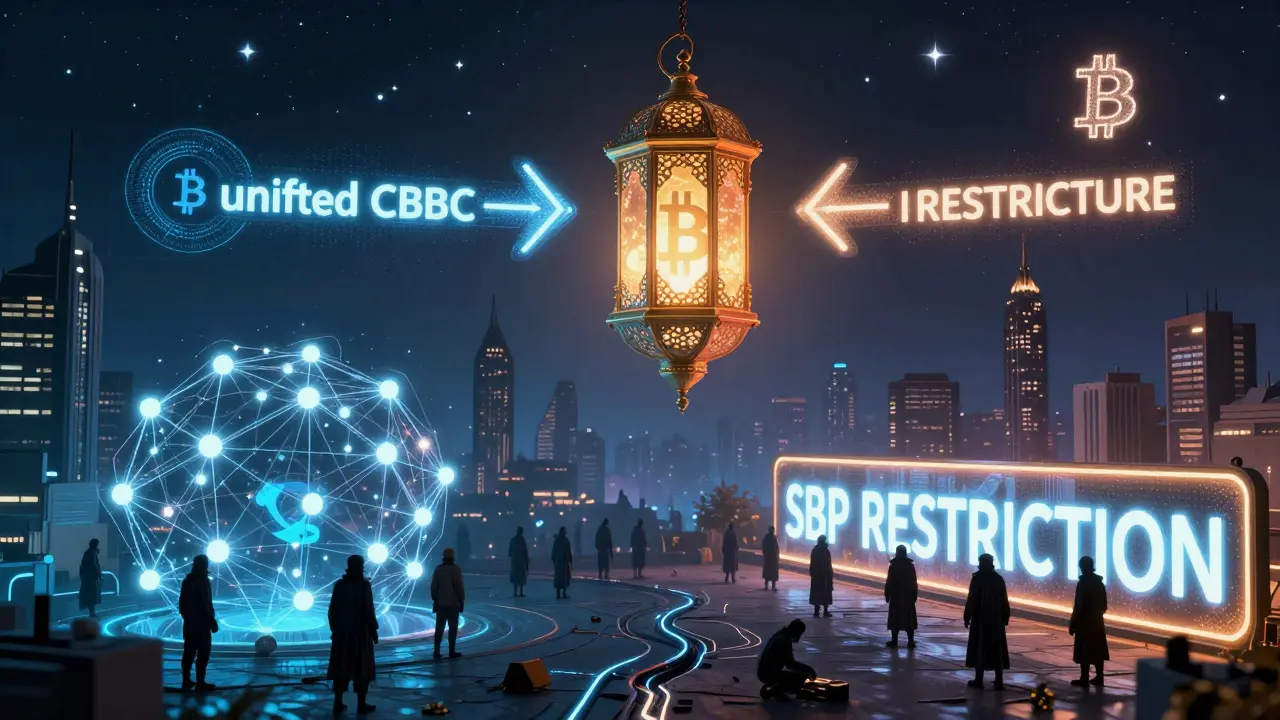
Here’s where things get messy. Even though mining is now legal under the Virtual Assets Act, the State Bank of Pakistan (SBP) still says digital currencies are not legal tender. Banks are still forbidden from dealing with crypto businesses. That means miners can’t open business bank accounts to pay for equipment, electricity, or staff salaries.
So how do they pay? Many use peer-to-peer exchanges, crypto-to-crypto swaps, or foreign wallets. Some hire third-party payment processors based overseas. It’s a workaround, not a solution. This disconnect between PVARA and SBP creates real operational headaches. A miner might be licensed, but still can’t get a business loan or pay taxes through a normal bank.
Analysts say this contradiction won’t last. The SBP is working on its own Central Bank Digital Currency (CBDC), and the 2024 amendments to the State Bank Act already laid the groundwork. The next step? A unified digital financial system where crypto and the national currency coexist under one regulatory roof.
Environmental Rules and Future Goals
Pakistan’s mining plan isn’t just about profit - it’s about sustainability. Draft guidelines from PVARA, released in August 2025, require all mining operations to use at least 70% renewable or repurposed energy by 2027. That means solar, wind, or excess coal power - not new fossil fuel plants.
There’s also a push to build local mining hardware expertise. Right now, most equipment is imported from China or the U.S. But PVARA is encouraging partnerships with Pakistani engineering schools to develop low-cost, energy-efficient ASIC designs. The goal isn’t just to mine Bitcoin - it’s to build the tools to do it.
Why This Matters for Pakistan’s Economy
Pakistan is the third-largest crypto adopter in the world, behind only the U.S. and India. Over 40 million people have crypto wallets. That’s a huge untapped market. By regulating mining, the government isn’t just trying to collect taxes - it’s trying to turn a grassroots movement into a formal industry.
Market analysts estimate Pakistan’s total crypto market value at $21 billion as of September 2025. If the 2,000 MW allocation is fully used, mining could contribute $3-4 billion of that within two years. That’s billions in foreign investment, thousands of tech jobs, and new export potential.
Even more importantly, it’s a signal to the world: Pakistan is open for digital business. This isn’t just about crypto. It’s about positioning the country as a tech-forward economy that can attract global innovation - even if it’s still sorting out its banking rules.
What’s Next?
The next 12 months will be critical. Phase 2 of licensing opens in early 2026. If domestic miners can meet the 100 PH/s threshold, we’ll see a wave of local operations. If they can’t, Pakistan’s mining sector might remain dominated by foreign firms.
The real test will be whether the government can fix the banking gap. Until miners can pay their bills through normal financial channels, the system will feel broken. But if they succeed - if a Pakistani miner can open a bank account, pay taxes, and buy equipment locally - then this becomes a blueprint for other developing countries.
Pakistan isn’t just catching up to the crypto world. It’s trying to lead it. Whether it works depends on how fast they fix the holes - and how willing they are to let innovation grow, even when it’s messy.
Is crypto mining legal in Pakistan in 2025?
Yes, crypto mining is legal in Pakistan as of July 2025, under the Virtual Assets Act. However, it’s only legal if you’re licensed by the Pakistan Virtual Asset Regulatory Authority (PVARA). Unlicensed mining is still a criminal offense.
Do I need a license to mine crypto in Pakistan?
Yes. All mining operations - whether you’re a large international firm or a local operator - must apply for a license through PVARA. There are two phases: Phase 1 (late 2025) is for large miners with over 1 EH/s hash rate. Phase 2 (early 2026) opens for smaller miners with at least 100 PH/s.
Can I use my home electricity to mine crypto?
No. Using residential electricity for mining is strictly prohibited. All mining operations must connect to industrial power lines with a minimum 500 kW capacity. This rule was put in place to prevent misuse of subsidized power and to meet IMF requirements.
How much tax do I pay on crypto mining income in Pakistan?
Mining income is taxed as regular income, with rates from 5% to 35% depending on your earnings. If you sell the coins you mined, you pay a flat 15% capital gains tax. All income must be reported using Form IT-1 by September 30 each year.
Can Pakistani banks help me with crypto mining?
No. The State Bank of Pakistan still prohibits banks from dealing with cryptocurrency businesses. Even licensed miners can’t open business bank accounts or get loans for mining equipment through local banks. Most use offshore payment processors or peer-to-peer crypto exchanges instead.
Are there any environmental rules for crypto mining in Pakistan?
Yes. PVARA’s draft guidelines require mining operations to use at least 70% renewable or repurposed energy by 2027. This includes excess coal power, solar, or wind. The goal is to avoid building new power plants and instead use existing surplus energy.
Is crypto mining Shariah-compliant in Pakistan?
Some mining models are being tested for Shariah compliance through regulatory sandboxes. These use profit-sharing structures instead of fixed rewards and avoid elements like interest or gambling. While not all mining is automatically halal, PVARA is actively working with Islamic scholars to create approved frameworks.
Can I start mining as a small business in Pakistan?
Yes, but not yet. Phase 1 of licensing (late 2025) is only for large operations. Small-scale miners can apply starting in Q1 2026, but they must have a minimum hash rate of 100 PH/s - which requires serious hardware investment. It’s not for hobbyists or home miners.


I'm a blockchain analyst and crypto educator who builds research-backed content for traders and newcomers. I publish deep dives on emerging coins, dissect exchange mechanics, and curate legitimate airdrop opportunities. Previously I led token economics at a fintech startup and now consult for Web3 projects. I turn complex on-chain data into clear, actionable insights.