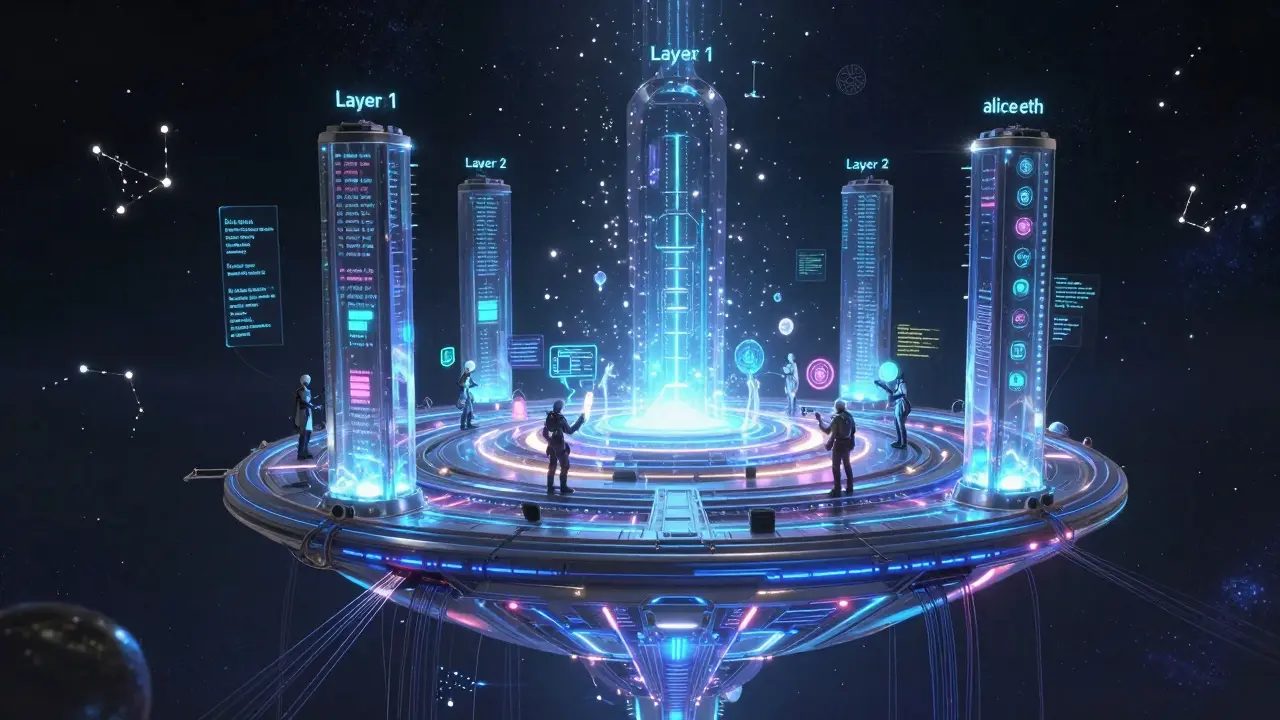
Most people think Web3 is just about crypto wallets and NFTs. But behind every dApp, every DeFi protocol, every NFT marketplace, there’s a whole stack of technologies working together - and most developers don’t even know where to start. If you’ve ever tried to build something on blockchain and got stuck because you didn’t understand how the pieces fit, this is for you.
What Is the Web3 Technology Stack?
Web3 isn’t a single tool or platform. It’s a layered system, like building a house. You can’t just pour concrete and call it done. You need foundations, framing, plumbing, wiring - and Web3 is no different. The stack is made up of interconnected layers, each handling a specific job so that decentralized applications can run without relying on companies like Google, Amazon, or Facebook.
Unlike Web2, where your data lives on a server owned by a corporation, Web3 spreads everything across thousands of computers. That means no single entity controls your identity, your money, or your content. But making that work? It takes a lot of moving parts.
Layer 0: The Physical Foundation
Layer 0 is the hidden backbone. Think of it as the internet itself - the cables, routers, and servers that carry data. But in Web3, it’s not just about bandwidth. It’s about how blockchains connect to the real world.
Layer 0 includes peer-to-peer networking protocols like libp2p, which lets nodes (computers in the network) find and talk to each other. It also covers consensus mechanisms that allow these nodes to agree on what’s true without a central authority. Proof of Stake (PoS) and Proof of Work (PoW) live here. Ethereum switched from PoW to PoS in 2022, cutting its energy use by over 99%. That wasn’t just a tweak - it changed how entire networks operate.
Some Layer 0 projects, like Polkadot and Cosmos, even let blockchains talk to each other. That’s called interoperability. Without it, you’d have hundreds of isolated blockchains, each with its own users and rules. Layer 0 makes them work as one big system.
Layer 1: The Core Blockchains
This is where most people start. Layer 1 is the main blockchain network - the one that processes transactions and stores data permanently. Ethereum is the most popular, but it’s not the only one.
Ethereum runs the Ethereum Virtual Machine (a decentralized computer that executes smart contracts). Every time you swap tokens, mint an NFT, or lend crypto, it’s happening inside the EVM. Other chains like Solana, Polygon, and Avalanche also have their own virtual machines, but they all do the same basic thing: run code that can’t be changed once deployed.
Smart contracts are written in languages like Solidity (for Ethereum) or Rust (for Solana). These aren’t like regular apps. Once you deploy a smart contract, you can’t fix bugs or update features. That’s why security matters more than speed. A single mistake can cost millions - and there’s no customer support to call.
Layer 1 blockchains are powerful but slow. Ethereum handles about 15 transactions per second. That’s fine for payments, but not for a game with 10,000 players. That’s where Layer 2 comes in.

Layer 2: Scaling the Network
Layer 2 solutions sit on top of Layer 1 blockchains to make them faster and cheaper. They don’t replace Ethereum - they use it as a secure anchor.
Rollups are the most common Layer 2 tech. They bundle hundreds of transactions into one, then post a single proof to Ethereum. That means you get Ethereum’s security without the congestion. Optimism and Arbitrum are two major rollups. Together, they process over 80% of all Ethereum Layer 2 traffic.
State channels and sidechains are other options. State channels let users transact privately between each other, only settling on-chain when they’re done. Sidechains run parallel blockchains with their own rules, then sync back to the main chain. Each has trade-offs: speed vs. security, cost vs. decentralization.
Without Layer 2, Web3 would be too expensive for everyday use. Sending a simple token transfer used to cost $50 during peak times. Now, on Layer 2, it’s under $0.10. That’s what made mass adoption possible.
Layer 3: The Developer Tools
This layer is where builders live. It’s not part of the blockchain itself - it’s everything you need to build on it.
Development frameworks like Hardhat and Foundry let you write, test, and deploy smart contracts locally before sending them live. Testing tools simulate attacks, check for bugs, and even mimic network congestion. You wouldn’t launch a website without testing it - why do it with $10 million in user funds?
APIs are critical too. QuickNode (a node provider that gives developers instant access to blockchain data) and Alchemy offer reliable connections to Ethereum and other chains. Running your own node? Possible, but expensive. Most developers use these services instead.
Then there’s decentralized storage. You can’t store a video or image directly on Ethereum - it’s too costly. That’s where IPFS (a peer-to-peer file storage system that hashes content to ensure integrity) and Filecoin come in. Files are split, encrypted, and stored across hundreds of nodes. The blockchain only keeps a hash - a digital fingerprint - proving the file hasn’t been tampered with.
Identity is another big piece. Web3 doesn’t use emails or passwords. Instead, users have wallet addresses like 0x742d35Cc6634C0532925a3b844Bc454e4438f44e. But that’s not user-friendly. Projects like Ethereum Name Service (a decentralized domain system that turns wallet addresses into human-readable names) let you use yourname.eth instead. It’s like having a username that’s owned by you, not a company.
Layer 4: The Apps You Use
This is the surface layer - the part users interact with. These are the dApps: Uniswap for trading, OpenSea for NFTs, Aave for lending, and so on.
Unlike Web2 apps, dApps don’t run on servers. They’re hosted on decentralized networks like IPFS or Arweave. When you visit a dApp, your browser loads the code directly from the network. There’s no company behind it - just code, and the people who use it.
Wallets like MetaMask or Phantom are the bridge between you and the blockchain. They sign transactions, store your keys, and show you your balance. Without them, you can’t interact with Web3. And unlike logging into Facebook, your wallet doesn’t track you. You own your data.
Frontend frameworks like React and Vue still work in Web3. But now they connect to smart contracts via libraries like ethers.js or web3.js. The UI looks familiar - buttons, forms, animations - but underneath, it’s all blockchain.
Why This Stack Matters
Web3 isn’t about replacing the internet. It’s about fixing its biggest flaw: control. Right now, your data belongs to companies. In Web3, it belongs to you.
Imagine a social network where you earn tokens for posting, not because a company rewards you - but because the rules are written into code. Or a loan system where anyone can lend money without a bank, and interest rates are set by algorithms, not boardrooms.
The stack makes that possible. Layer 0 connects the network. Layer 1 secures it. Layer 2 makes it fast. Layer 3 lets you build it. Layer 4 lets you use it.
And here’s the truth: if you’ve built a website before, you already know 70% of what you need. The rest is learning how to write code that can’t be changed, how to store data without a server, and how to let users own their own keys. It’s not magic. It’s just different.
What’s Next?
Web3 is still young. Layer 2 scaling is improving. Identity systems are getting better. Cross-chain bridges are becoming safer. And tools are getting easier to use.
But the core hasn’t changed: decentralization isn’t a feature. It’s the foundation. And if you want to build the next generation of the internet, you need to understand how the stack holds it all together.
What’s the difference between Web2 and Web3?
Web2 is centralized. Your data lives on servers owned by companies like Google or Meta. You log in with an email and password. Web3 is decentralized. Your data is stored on a blockchain or distributed network. You log in with a wallet, and you own your identity, your assets, and your data. No company controls it.
Do I need to know how to code to use Web3?
No. You can use dApps like Uniswap or OpenSea without writing a single line of code. But if you want to build Web3 apps - like a new DeFi platform or NFT marketplace - then yes. You’ll need to learn smart contract languages like Solidity, how to use development tools like Hardhat, and how to connect frontend interfaces to blockchain data.
Why is Ethereum the most used blockchain for Web3?
Ethereum has the largest developer community, the most mature tools, and the widest adoption of smart contracts. It was the first blockchain to support programmable money. Even though other chains are faster or cheaper, Ethereum’s network effect - the number of users, projects, and wallets built on it - keeps it dominant. Over 70% of all dApps still run on Ethereum or its Layer 2s.
Can I build a Web3 app without using blockchain?
Not really. If you’re not using a blockchain, you’re not building Web3. You might be using crypto or NFTs, but if your app still relies on a central server to store user data or control access, it’s still Web2. Web3 requires decentralization - data stored on distributed networks, governed by code, not companies.
Is Web3 secure?
The blockchain itself is extremely secure - it’s designed to be tamper-proof. But most hacks happen at the application level: smart contracts with bugs, poorly coded wallets, or phishing scams. The tech is safe. The human side isn’t. Always audit smart contracts, use trusted wallets, and never share your seed phrase.


I'm a blockchain analyst and crypto educator who builds research-backed content for traders and newcomers. I publish deep dives on emerging coins, dissect exchange mechanics, and curate legitimate airdrop opportunities. Previously I led token economics at a fintech startup and now consult for Web3 projects. I turn complex on-chain data into clear, actionable insights.